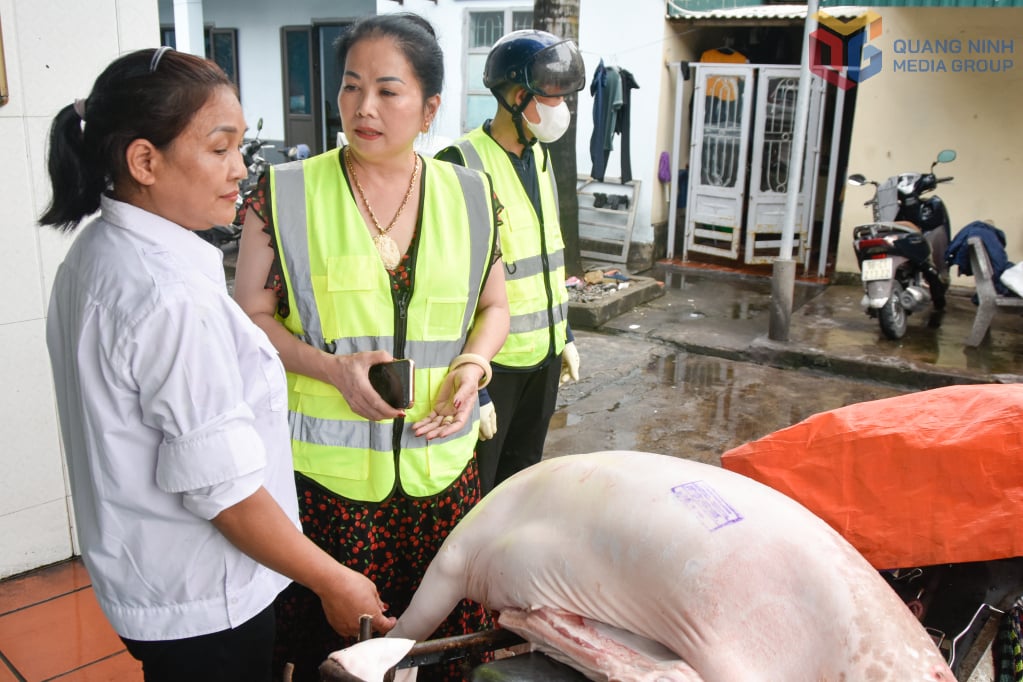
Leaders of Thai Hoa Joint Stock Company and veterinary staff inspect the quality of pork before it is released to the market.
As one of the large-scale centralized slaughterhouses in the Quang Hanh area of Cam Pha, Thai Hoa Joint Stock Company currently has a capacity of processing nearly 150 pigs per day. According to the procedures applied here, all live pigs entering the facility must have a quarantine certificate and a veterinary hygiene record from the Department of Livestock and Veterinary Medicine at the breeding site. Once all the required information is provided, company staff receive the pigs into the facility through a separate entrance, disinfect them thoroughly, and ensure cleanliness before they are moved to the slaughter line. All products that do not meet the requirements, especially those with abnormal lymph nodes or tapeworm infestations, are immediately discarded and destroyed; they are absolutely not used. The finished products are also immediately inspected and monitored for quality by veterinary officers, certified, and stamped with a seal from the Center for Agricultural Technical Services before being released to the market.
Operating in a specialized industry, the company always prioritizes environmental factors. The slaughterhouse is located far from the urban center to minimize noise pollution to residents. All wastewater is collected and treated according to strict procedures before being released into the natural environment. Every six months, the company sends wastewater samples for testing and analysis to compare with the limits in QCVN 40:2025/BTNMT - National Technical Standard on Industrial Wastewater. The wastewater sample analysis report is an integral part of the company's annual environmental records, demonstrating the company's compliance and commitment to environmental protection. Furthermore, the retained documents serve as important legal evidence when inspected and evaluated by relevant authorities.
It has been learned that the company provides regular employment for 40 people, with an average income of 10 million VND per person per month. Occupational safety and hygiene are always given priority, regularly inspected, and reminded to become a standard practice within the company and a matter of self-awareness for each individual. Specifically, this includes providing sufficient personal protective equipment; regularly inspecting fire safety, electrical and water systems serving production; and periodically sending staff and workers to training courses on food safety and hygiene.
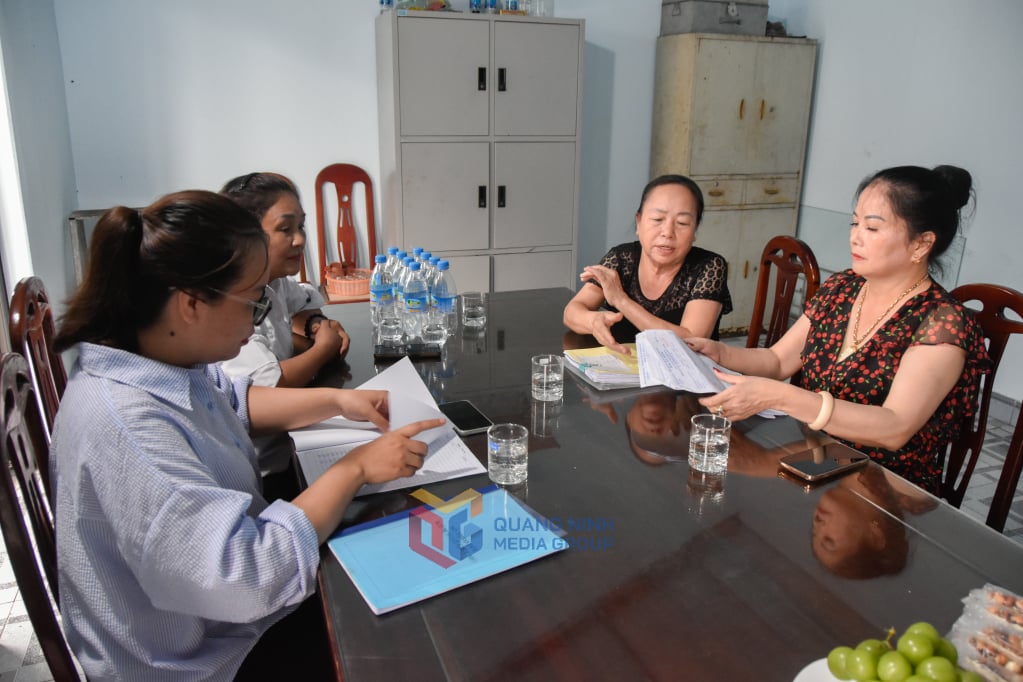
Thai Hoa Joint Stock Company regularly reviews documents and records certifying veterinary hygiene conditions, animal disease safety, and food safety in accordance with the law.
Ms. Hoang Tu Lieu, Director of Thai Hoa Joint Stock Company, stated: "Establishing a rigorous process and ensuring 100% compliance by all staff and workers has become a top priority in the company's operations. This is a vital criterion for the business, especially as food safety and hygiene are becoming a pressing issue of paramount concern to society as a whole; directives from the central and provincial governments are focusing on tightening the management of animal slaughtering activities to protect public health. Thanks to this, for many years, the company's products have been widely accepted and trusted, appearing in wholesale markets, local markets, and collective kitchens of many large organizations and businesses in the locality."
A centralized slaughtering model like the one at Thai Hoa Joint Stock Company, when implemented rigorously and systematically, will significantly contribute to resolving environmental pollution in residential areas caused by small, unregulated slaughterhouses. At the same time, it will help specialized agencies and local authorities manage and control more effectively, limiting the risk of outbreaks of dangerous animal diseases.
The Provincial People's Committee has just issued Document No. 1982/UBND-TC (dated June 18, 2025) "On rectifying the management of slaughtering activities and the process of controlling animal slaughter to ensure disease safety and food safety." Accordingly, the Provincial People's Committee requests localities to strengthen surprise inspections and strictly handle acts of slaughtering sick or dead pigs without veterinary control; strengthen supervision of facilities collecting, processing, and manufacturing animal products, especially in border areas; suspend unlicensed facilities, those that do not meet hygiene conditions, and those using banned chemicals and additives. At the same time, they are to continue closely monitoring and controlling trails, open routes, and seaports to promptly prevent the illegal transportation of animal products of unknown origin across the border... |
Van Ba
Source: https://baoquangninh.vn/no-luc-de-san-pham-an-toan-den-tay-nguoi-tieu-dung-3365562.html


![[Photo] Secretary of the National Assembly Party Committee, Chairman of the National Assembly presides over the meeting of the Standing Committee and Executive Committee of the National Assembly Party Committee.](https://vphoto.vietnam.vn/thumb/1200x675/vietnam/resource/IMAGE/2026/06/03/1780480353201_ndo_br_bnd-2585-jpg.webp)
![[Photo] First session of the 14th Congress of the Vietnam Trade Union](https://vphoto.vietnam.vn/thumb/1200x675/vietnam/resource/IMAGE/2026/06/03/1780465947883_ndo_br_img-3852-jpg.webp)
![[Photo] General Secretary and President To Lam presides over a meeting with the Central Organizing Committee.](https://vphoto.vietnam.vn/thumb/1200x675/vietnam/resource/IMAGE/2026/06/03/1780482764658_a1-bnd-4741-3342-jpg.webp)
































![[Video] Sunset at Lap An Lagoon – Where the sun sets over the fishing nets](https://vphoto.vietnam.vn/thumb/1200x675/vietnam/resource/IMAGE/2026/05/31/1780192137701_beach-landscape-sea-water-nature-grass-745871-pxhere-com.jpeg)
























Comment (0)