

The Royal Swedish Academy of Sciences has decided to award the 2024 Nobel Prize in Economics to three scientists: Daron Acemoglu and Simon Johnson, both from the Massachusetts Institute of Technology (MIT), and James A. Robinson from the University of Chicago, according to an announcement posted on The Nobel Prize website yesterday afternoon (October 14th, Vietnam time). They will receive medals, certificates, and 11 million Swedish kronor (approximately 26.3 billion Vietnamese dong).
The 2024 Nobel Prize in Economics will be awarded to three American economists.
Winning the Nobel Prize with a New Approach
Jakob Svensson, chairman of the Nobel Prize Committee for Economics, stated that the vast income gap between nations is one of the biggest global challenges today. The wealthiest 20% of the world's nations are now approximately 30 times richer than the poorest 20%. While less developed nations have become more prosperous, it remains very difficult for them to catch up with the wealthiest.
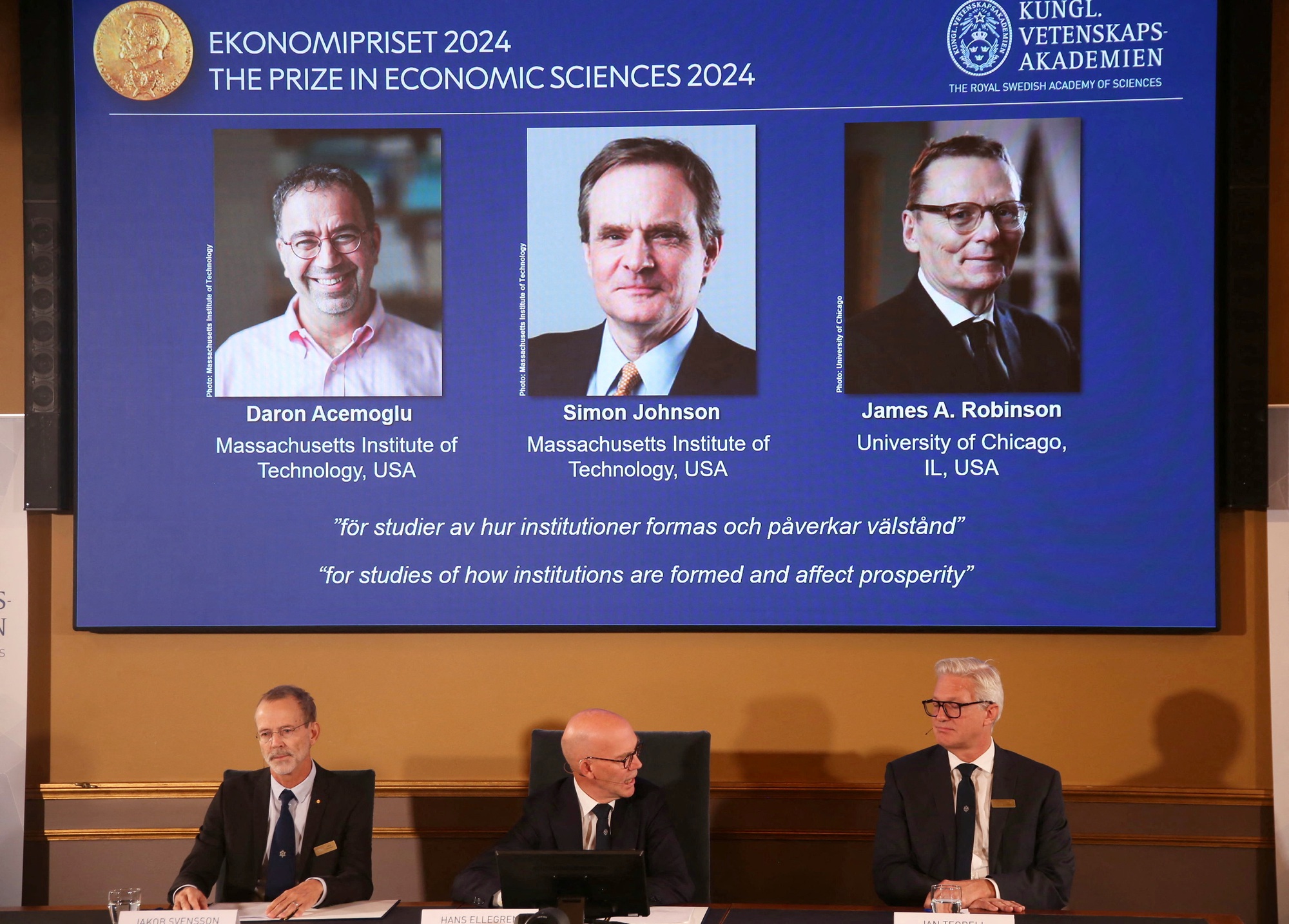
The three scientists who won the 2024 Nobel Prize in Economics are shown on screen during the announcement ceremony.
According to Svensson, while this issue is not new, the three scientists have made a pioneering breakthrough in their approach, both experimentally and theoretically, helping to clarify the root causes of the differentiation among nations.
By studying the various political and economic systems that emerged during the European colonial period, three American scientists were able to demonstrate the relationship between institutions and prosperity. The three Nobel laureates in Economics explain that in many countries where institutions dominated during colonization, the people tended to prosper more later. This is a key reason why former colonies that were once wealthy are now poor, and vice versa.
Chairman Svensson added that research shows many countries later face exploitative institutions and low economic growth. "Introducing inclusive institutions creates long-term benefits for everyone, but exploitative institutions provide short-term benefits for those in power," Svensson explained.
Significance and concerns
Mr. Svensson stated that, empirically, the work of the three American scientists has significantly advanced the study of the causal effects of institutions on prosperity. The three scientists identified the historical origins of weak institutional environments, a phenomenon evident in many low-income countries today. Theoretically, the scientists' research explains why exploitative economic institutions and authoritarian regimes often persist for a long time despite the potential benefits of reform.
Daron Acemoglu expressed his delight at receiving the Nobel Prize news. However, he also expressed concern that institutions everywhere, including the US and Europe, are weakening and support for democracy is declining. "Although democracy has the potential to drive rapid growth and achieve consensus on many difficult issues, countries are not yet fully exploiting that potential," said Acemoglu.
The 2024 Nobel Prize season has come to an end.
The 2024 Nobel Prize in Economics has concluded the 2024 Nobel Prize season. To date, the Nobel Prize in Economics has been awarded 56 times. The youngest recipient was 46 years old, and the oldest was 90. Last year, the award went to American economist Claudia Goldin for her significant contributions to a better understanding of women's employment. This is a remarkable achievement, as she is one of only three women to have received the Nobel Prize in Economics since its establishment in 1969.
Source: https://thanhnien.vn/nobel-kinh-te-2024-vinh-danh-3-nha-khoa-hoc-my-185241014213617849.htm




































































































Comment (0)