

(NLĐO) - 250 million years ago, a near-apocalyptic event wiped out 80% of life on Earth. Only one place remained unaffected.
According to Live Science , scientists have just discovered a shocking series of fossils in the Xinjiang region of China, suggesting that the area was once a "fortress against the apocalypse" when Earth experienced the worst extinction event in history.
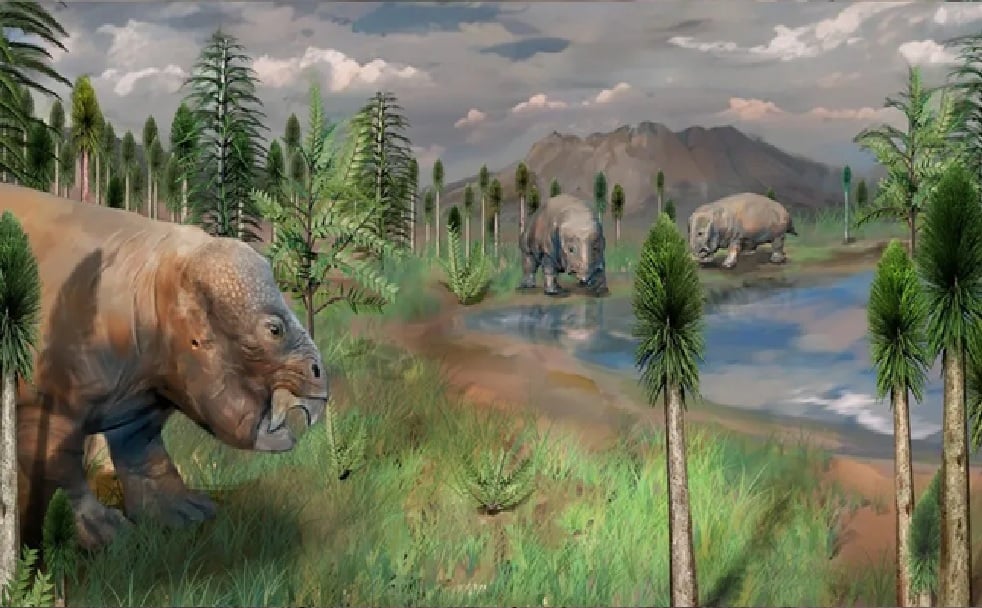
The region that is now Xinjiang, China, may have once been a "fortress against the apocalypse" during the Diphomass mass extinction event. (Illustration: LIVE SCIENCE)
Approximately 250 million years ago, life on Earth faced a terrible challenge.
At that time, the supercontinent Pangea was in the process of breaking apart, but all the landmasses on Earth were still largely clustered together, with new continents separated by shallow seas.
A major eruption from a volcanic system called the Siberian Traps appears to have pushed carbon dioxide levels to extremely high levels, more than six times higher than they are today. This caused global warming and ocean acidification, leading to ecosystem collapse.
This near-apocalyptic event, known as the "Permian mass extinction," caused the disappearance of 80% of life on the planet.
However, fossils hidden in sediments in an area of Xinjiang suggest that, even during that terrible time, a relatively healthy ecosystem still existed there.
Inside this "apocalypse fortress," the coniferous forests continue to thrive, supplemented by spore-producing ferns.
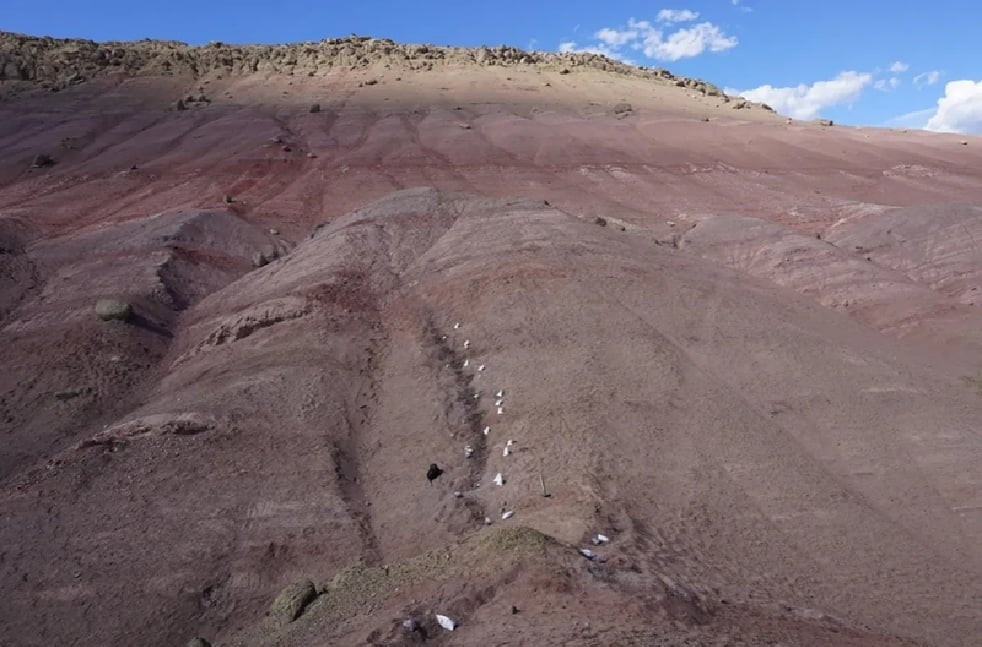
This area, now a vast desert in Xinjiang, was once lush and green during the most terrible period in Earth's history - Photo: NIGPAS
The research team, led by Professor Wan Yang from the University of Missouri Science and Technology (USA), sought to find answers to the "invincibility" of this region.
According to a paper published in the scientific journal Science Advances, rocks containing zircon-crystal-bearing ash layers in the Xinjiang desert have helped researchers pinpoint a sedimentary layer that is consistent with the Dichotomy mass extinction event.
These layers are filled with highly adaptable plant species, including trees with large root systems or underground stems, which can live for hundreds of years and have a high seed production capacity.
This survival may be particularly possible in humid, high-latitude regions. The fossil site in present-day Xinjiang is a desert, but at that time it was dotted with lakes and rivers, just a few hundred miles from the ancient coast.
At the time of the Earth's catastrophe, the climate here was only slightly drier, not experiencing the severe drought seen in most other parts of the world .
The survival of plants could mean that many animals also find suitable shelter, with enough food to help them get through the harsh period.
According to the authors, the findings in Xinjiang suggest that there may be other "doomsday strongholds" elsewhere in the world. Unlike the ocean, climate change on land is uneven, and some temperate regions may be able to weather it.
Source: https://nld.com.vn/phat-hien-thanh-tri-chong-tan-the-250-trieu-nam-o-trung-quoc-19625031610170239.htm






















![[Photo] Prime Minister Pham Minh Chinh holds a phone call with the CEO of Russia's Rosatom Corporation.](/_next/image?url=https%3A%2F%2Fvphoto.vietnam.vn%2Fthumb%2F1200x675%2Fvietnam%2Fresource%2FIMAGE%2F2025%2F12%2F11%2F1765464552365_dsc-5295-jpg.webp&w=3840&q=75)













































Comment (0)