

|
Hoa Dong Agricultural Service Cooperative (Tay Hoa district) is expanding its raw material area to produce more lotus-based products. Photo: NGOC HAN |
Pioneering the development of OCOP products.
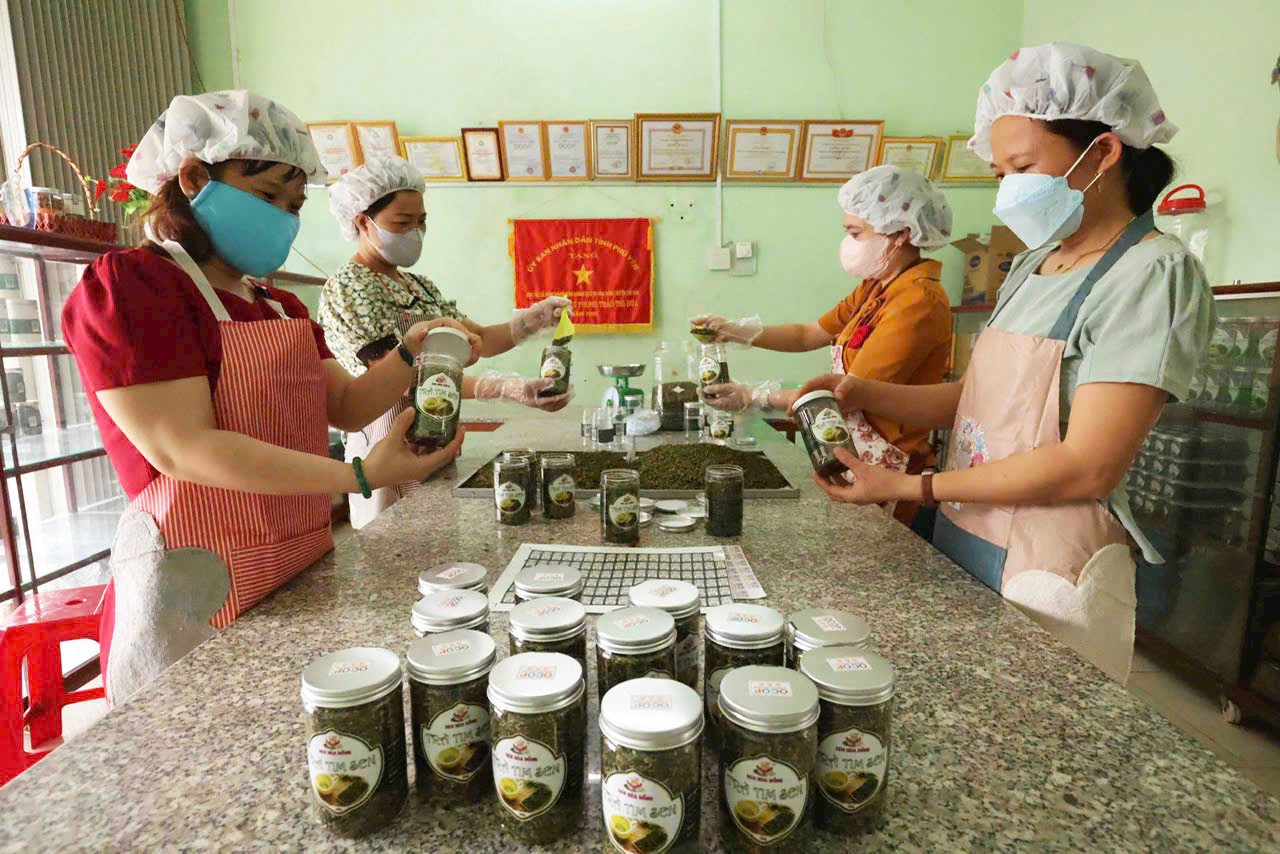
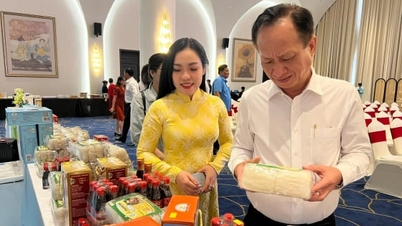
According to the Provincial Cooperative Union, developing cooperatives associated with OCOP products plays a crucial role in the process of transforming agricultural production thinking into an agricultural economy . With their flexibility, proactiveness, and keen market awareness, many agricultural cooperatives in the province have developed OCOP products, meeting customer demands, linking production, guaranteeing raw material sales, and increasing income for farmers.
Hoa Dong Agricultural Service Cooperative (Tay Hoa district) is one of the pioneering cooperatives in developing OCOP-certified products. Currently, the cooperative has three lotus-based products that have achieved OCOP 3-star certification. This not only affirms and elevates the cooperative's lotus brand but also contributes to increasing its reputation and strengthening consumer trust. According to Mr. Nguyen Thanh Minh, Director of the cooperative, in the past, local people mainly grew lotus for its seeds to sell to traders, resulting in a rather unstable market. By grasping the mechanisms and policies supporting value chain linkages in agricultural production and consumption, the cooperative has successfully built a lotus cultivation model, linking production to on-site processing, bringing double benefits and creating high and stable income for farmers.
“The cooperative is finalizing the paperwork to upgrade its lotus seed powder product to OCOP 4-star and continues to develop other processed lotus products; at the same time, it is converting and expanding the lotus cultivation area, striving to increase the lotus cultivation area in the entire commune to 40 hectares by the end of 2025,” Mr. Minh added.
Having succeeded with the Hoa Vang fragrant rice brand achieving 3-star OCOP, in recent times, An Nghiep Agricultural Cooperative (Tuy An district) has always been a bright spot for other cooperatives to learn from in supporting members to develop the value chain from production, processing to product consumption.
Mr. Tran Tan Khoa, Director of this cooperative, said: "Building a supply chain and having commercial products has helped the cooperative gain a foothold in the market and expand cooperative production relationships. Now, not only do farmers trust us, but many partners are also seeking to cooperate in consuming our products. Currently, the cooperative is continuing to implement the production linkage model, creating two new products: Hoa Vang fragrant rice and Hoa Vang brown rice with the Blood Dragon rice variety, to be recognized as OCOP products."
Accelerate implementation
After 5 years of implementing the OCOP Program, the province currently has 389 OCOP products that have achieved 3-4 stars. However, most of the units that have received OCOP certification in the province are enterprises and family businesses; the number of cooperatives with OCOP products is very small. According to statistics from the Provincial New Rural Development Coordination Office, currently only more than 20 cooperatives and cooperative groups have products participating in the OCOP Program. This number is truly too small compared to the existing potential of the operating cooperatives.
According to many cooperatives, developing OCOP products from cooperatives is facing several difficulties. Specifically, during the implementation of the OCOP program, cooperatives must expand production, change technology, establish value chain linkages, and require significant capital. However, currently, most cooperatives are small in scale, and access to credit, value chain linkages, and product outlets remains challenging.
With detailed and comprehensive product ranking criteria and guidance from relevant authorities, cooperatives have recognized the strengths and weaknesses of each product, thereby making adjustments, innovations, and improvements to their processing and production processes in a more scientific way, and developing long-term product development strategies. Through the OCOP program, many cooperatives have leveraged their internal resources, innovated both qualitatively and quantitatively, and affirmed the role and significance of the collective economy.
Mr. Dang Kim Ba, Chairman of the Provincial Cooperative Union
On the other hand, while the province's cooperative products are diverse in type and quantity, the cooperatives have not paid enough attention to design, labeling, packaging, and necessary certifications such as food safety, traceability, and intellectual property rights. Therefore, most cooperative products do not meet market requirements, resulting in low competitiveness.
Mr. Nguyen Van Hong, Vice Chairman of the People's Committee of Dong Hoa Town, said: To date, Dong Hoa has 34 products that have achieved OCOP 3-star rating; including 8 OCOP products from 3 cooperatives. Currently, the cooperatives are continuing to complete their dossiers and register to participate in the OCOP Program; striving to have an additional 10 OCOP products recognized in 2025.
According to Mr. Ho Van Nhan, Deputy Head of the Provincial New Rural Development Coordination Office, cooperatives in the province still have much untapped potential. Many cooperatives have small-scale production, weak internal capacity, limited ability to develop production and business, and are not yet bold enough to expand their business sectors or diversify products to suit local advantages and market mechanisms. Many cooperatives have not yet built brands for their key products, and most are unprocessed raw products.
“To improve this situation, in the coming time, the agricultural sector will focus on coordinating with relevant departments, agencies, and localities to support cooperatives in identifying key products, aiming for production linked to the market, especially focusing on building brands, individual trademarks, geographical indications, and traceability for products. For cooperatives that already have OCOP products, the unit will create conditions for them to participate in trade promotion activities, trade fairs and exhibitions, and connect supply and demand for OCOP products within and outside the province. We will also strengthen training and development of OCOP products, bring OCOP products to e-commerce platforms, and support cooperatives in accessing capital to invest in machinery and equipment for production and improve product quality…”, Mr. Nhan added.
Source: https://baophuyen.vn/kinh-te/202504/phat-trien-san-pham-ocop-tu-cac-hop-tac-xa-7487ed6/





















































































![[Infographic] Many activities at the 96th anniversary commemoration of the death of Deputy Scholar Nguyen Sinh Sac](https://vphoto.vietnam.vn/thumb/402x226/vietnam/resource/IMAGE/2025/12/11/1765441454787_infographic-nhieu-hoat-dong-tai-le-gio-lan-thu-96-cua-cu-pho-bang-nguyen-sinh-sac20251211010322.webp)














Comment (0)