

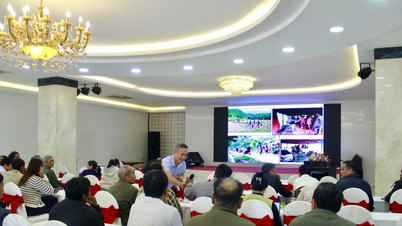
On the morning of May 17th, the Provincial Cultural and Film Center, in coordination with the Thach Thanh District People's Committee, organized a training course on choreography, rehearsals, and provided props and costumes for the Thach Lam commune's performing arts team to serve community tourism at the Thac May Tourist Area.

The training course contributes to preserving the traditional cultural values of the Muong ethnic people in Thach Lam commune and promotes community tourism development in the Thac May tourist area.
The training course was attended by 50 participants, including artisans, grassroots cultural and artistic leaders, and members of the Thach Lam commune's cultural and artistic troupe. Within the framework of the training course, participants were guided on methods of choreographing and developing model folk art programs to serve tourists and celebrate local holidays and anniversaries.
In the practical part, trainees are taught and guided on how to perform folk songs, folk dances, and folk music of the Muong ethnic group, as well as new folk-inspired songs praising the Party, President Ho Chi Minh, and the homeland; they are also guided in directing and creating a model folk art performance for the folk art troupe, lasting from 30 to 35 minutes, to serve tourists, community cultural activities, and programs celebrating local holidays and anniversaries; and they learn methods for organizing a cultural exchange performance, interacting with the people and tourists from all over.

On this occasion, the Provincial Cultural and Film Center provided the Thach Lam commune's performing arts troupe with traditional Muong ethnic costumes (brocade shirts, brocade skirts, slingshots, headscarves; men's attire); and props (brocade dance scarves with tassels and silver coins, silk fans, bamboo cymbals sprayed with glitter).
Through this training program, the Thach Lam commune's performing arts team will improve its performance, contributing to the preservation of traditional culture and promoting community tourism development in the locality.
Manh Cuong
Source















![[Photo] Prime Minister Pham Minh Chinh holds a phone call with the CEO of Russia's Rosatom Corporation.](/_next/image?url=https%3A%2F%2Fvphoto.vietnam.vn%2Fthumb%2F1200x675%2Fvietnam%2Fresource%2FIMAGE%2F2025%2F12%2F11%2F1765464552365_dsc-5295-jpg.webp&w=3840&q=75)







































Comment (0)