

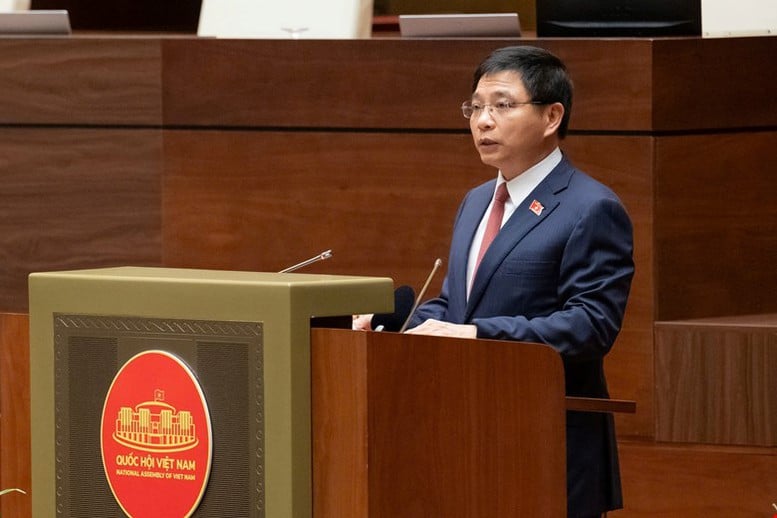
Minister of Finance Nguyen Van Thang presented the Proposal
Thoroughly resolve practical problems
On the morning of December 8, the National Assembly listened to the Presentation and examination report on the draft Law amending and supplementing a number of articles of the Law on Value Added Tax (VAT).
Minister of Finance Nguyen Van Thang said that this amendment is considered by the Government to be urgent and necessary to promptly overcome the consequences of natural disasters, storms and floods, soon restore production and business, especially in the agricultural sector, and at the same time remove "bottlenecks" in VAT refunds.
The Government's submission stated that after the VAT Law No. 48/2024/QH15 takes effect from July 1, 2025, many recommendations and reflections from associations and enterprises have pointed out practical difficulties arising from VAT policies in the fields of agriculture, animal feed and tax refund conditions.
The amendment of this Law is carried out in the spirit of Resolution 66 of the Politburo and Clause 2, Article 26 of the Law on Promulgation of Legal Documents, allowing the promulgation of laws right at the ongoing National Assembly session to resolve urgent issues.
The Minister of Finance said that the draft Law focuses on amending three main contents, aiming to thoroughly resolve practical shortcomings.
Firstly, agricultural products are not subject to VAT but are still eligible for input deductions, the content of which has been regulated stably since 2014, specifically, enterprises, cooperatives, and cooperative unions that buy and sell crop, forest, livestock, and aquatic products (not yet processed into other products or only through normal preliminary processing) to other enterprises, cooperatives, and cooperative unions are not subject to VAT.
Input VAT of goods and services not subject to VAT is fully deductible. This regulation has been implemented stably for many years and has not affected the state budget revenue. The amendment will reduce the burden of administrative procedures and at the same time contribute greatly to supporting the export of agricultural, forestry and fishery products, because enterprises do not have to pay in advance to pay taxes and then go through tax refund procedures, avoiding wasting time and opportunity costs.
Currently, according to reports, coffee industry enterprises have to pay about 5,000 billion VND, food industry about 2,016 billion VND and pepper and spice industry about 2,162 billion VND to pay input VAT. Credit institutions do not disburse this tax when providing working capital, causing financial pressure for enterprises.
Second, ensure a consistent tax policy for animal feed. The Government submitted to the National Assembly to remove the content "products of crops, planted forests, livestock, aquaculture, and fishing that have not been processed into other products or have only undergone normal preliminary processing and are used as animal feed or medicinal materials shall apply VAT at the tax rate prescribed for products of crops, planted forests, livestock, and aquaculture" currently stipulated in Clause 5, Article 9, Law on VAT No. 48 to ensure the consistent application of value added tax according to the provisions of the law on animal feed, ensuring equality with imported animal feed, because imported animal feed is not subject to tax, while domestically produced animal feed has an input VAT of 5%, so it must be included in the cost to increase the selling price.
This regulation will remove difficulties for agricultural production, especially in the context of the agricultural sector being heavily affected by the consequences of natural disasters and prolonged floods.
Third, remove the provision on tax refund conditions: "The buyer is only entitled to a tax refund when the seller has declared and paid taxes" (at Point c, Clause 9, Article 15, Law on VAT 2024). This provision, although added in 2024 to prevent fraud, has led to a situation where export enterprises are delayed in refunding taxes because they have to wait to determine that the seller has declared and paid taxes. This causes difficulties and risks for tax refund enterprises, because they do not have legal or technical tools to check the tax compliance status of the seller. Many opinions also reflect that this provision is not consistent with the principle of independent responsibility of the buyer and seller.
According to the proposal, tax refund inspection and supervision will be carried out consistently according to the provisions of the law on tax administration, especially when the draft revised Law on Tax Administration being submitted to the National Assembly has added provisions to more closely manage taxpayers.
Due to the urgency, the Government proposed that the draft Law will take effect from January 1, 2026 to provide timely support to the agricultural sector and remove bottlenecks for businesses.
Anticipate and clarify possible risks, frauds and legal gaps for officials in VAT refund work.
Examining the amendment and supplement of a number of articles of the Law on Value Added Tax, Chairman of the Economic and Financial Committee Phan Van Mai said that the Committee agreed that receiving opinions from relevant parties during the law implementation process is necessary to promptly find solutions to remove obstacles and bottlenecks for people and businesses.
The contents proposed by the Government to amend are all provisions to be considered when amending the Law on Value Added Tax in 2024 and taking effect from July 1, 2025. Many opinions in the Economic and Financial Committee suggested careful consideration because the law and guiding documents have just been implemented and there is not enough time for comprehensive assessment.
The Economic and Financial Committee believes that the main problem lies in the slow tax refund process. Therefore, it is necessary to clearly distinguish which content really needs to be amended by law, which content belongs to the implementing organization or needs to be handled in sub-law documents. At the same time, it is necessary to ensure that there are no loopholes, causing revenue loss and in accordance with regulation 188.
Regarding authority, many opinions believe that it is not necessary to submit to the National Assembly to amend the law at this session. The review agency proposed that in case of immediate need to handle bottlenecks, the Government can issue a Resolution according to Resolution No. 206 of the National Assembly, then conduct a comprehensive assessment to propose amending the law before March 2027.
However, in order to promptly resolve difficulties for businesses and during the 10th session, the National Assembly Standing Committee agreed to submit the draft law to the National Assembly for consideration at this session. The Chairman of the Economic and Financial Committee emphasized and requested the drafting agency to carefully assess, anticipate and clarify the risks, frauds and legal gaps for officials in the VAT refund work that may occur. Handling measures and responsibilities of state management agencies in cases of VAT refund invoice fraud causing loss of revenue to the budget.
Phuong Lien
Source: https://baochinhphu.vn/thao-go-diem-nghen-trong-hoan-thue-gtgt-102251208114029544.htm


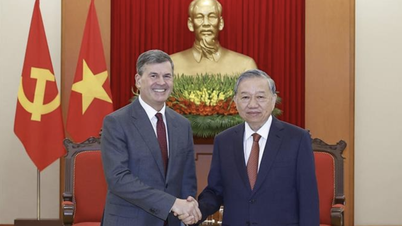
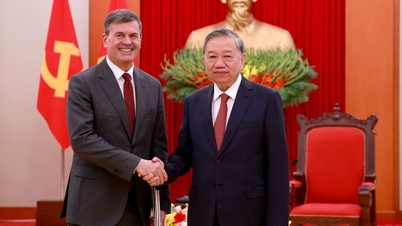
![[Photo] General Secretary To Lam receives the Director of the Academy of Public Administration and National Economy under the President of the Russian Federation](/_next/image?url=https%3A%2F%2Fvphoto.vietnam.vn%2Fthumb%2F1200x675%2Fvietnam%2Fresource%2FIMAGE%2F2025%2F12%2F08%2F1765200203892_a1-bnd-0933-4198-jpg.webp&w=3840&q=75)






















































































Comment (0)