

Advanced, robot-assisted devices have been used on children, showing faster recovery times, less post-operative pain, and shorter hospital stays.
Reece, a 7-year-old boy in England, has become the first child in the country to undergo kidney surgery using advanced, robot-assisted equipment. Reece suffered from a urethral obstruction causing urinary retention. "He went to the park and fell into a pole. He said he was fine, but then later that evening he went to the toilet and noticed some blood in his urine. At the hospital, the doctors did scans and found an obstruction," Reece's mother said.
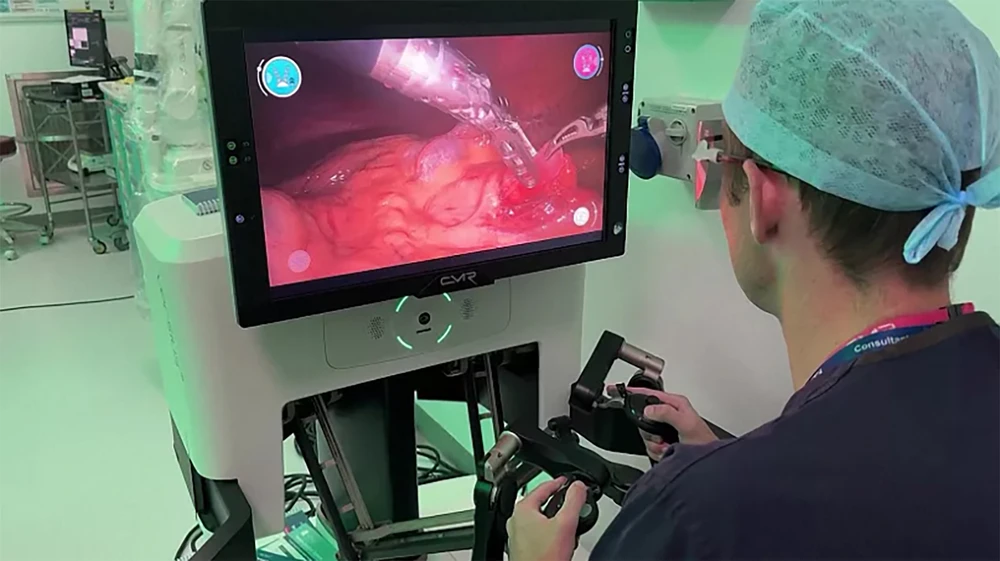
Laparoscopic pyelonephrectomy is a surgical procedure performed to treat obstructions and repair narrowing of the ureter. Traditional surgery for this procedure can cause several complications. Ewan Brownlee, a consultant pediatric urologist at Southampton University Hospital, who performed the surgery, said: "The two traditional methods are open surgery, which involves making a relatively large incision and doing everything manually, or laparoscopic surgery, which involves small incisions in the abdomen."
The robotic assistive device, developed by Cambridge-based CMR Surgical Ltd, can help achieve precision unmatched by humans through the use of small surgical instruments and manual controls that assist the robot, as well as a magnified high-definition display. Dr. Brownlee added: "The robotic assist is inside, moves as flexibly as a wrist, and is controlled by an external joystick. This joystick remains entirely under the surgeon's control."
The NHS Trust Guy's and St Thomas in London stated that by 2023, most prostate, kidney, and lung cancer surgeries will be performed roboticly... According to Southampton Children's Hospital, this robot has advanced precision and control capabilities, allowing its use on young patients. The robotic arm used in Reece's surgery has a 720-degree range of motion, allowing the use of surgical instruments small enough to perform complex procedures.
"When I first heard that there would be a surgical robot for my son, I was a little worried. After learning that there would be a doctor operating the robot, I felt more at ease," said Reece's father. Reece was discharged from the hospital a day after the surgery and is expected to make a full recovery.
Surgeons participating in the trial hope that robot-assisted pediatric surgery will become commonplace worldwide . "I hope that there will be more minimally invasive procedures available for children around the world. Robot-assisted technology will make these minimally invasive procedures easier to perform," said Dr. Brownlee. Southampton Children's Hospital said it will test the device on 150 pediatric patients in an upcoming study.
LAM DIEN
Source: https://www.sggp.org.vn/tien-bo-y-khoa-nho-cong-nghe-post753799.html



















































































Comment (0)