

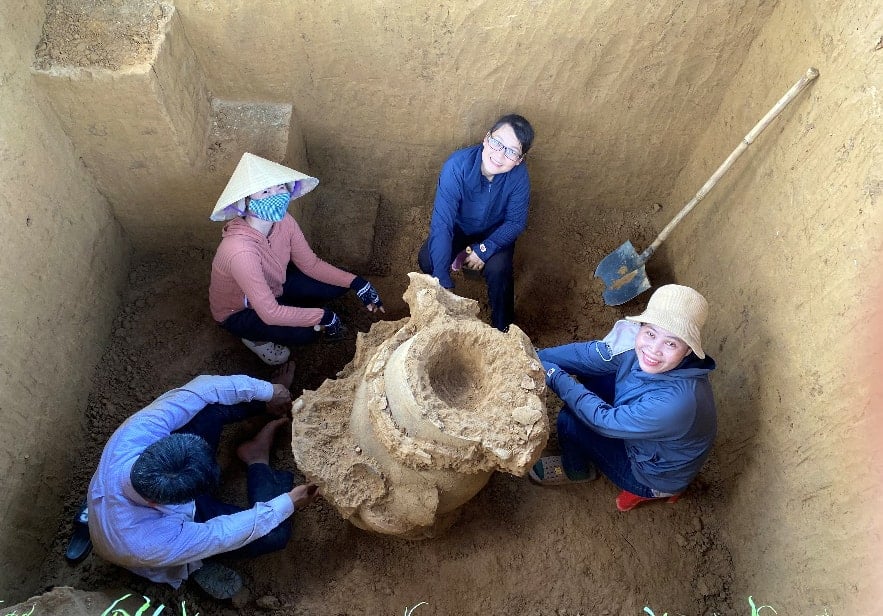
During our survey of archaeological sites in Quang Nam, we used a combination of field surveying methods and GPS/GIS software to collect field data.
The distribution pattern of historical sites
Following that pattern, during our investigation, survey, and inspection of bends along the main river branches and tributaries in the mountainous region of Quang Nam, we discovered many new Sa Huynh cultural relics.
In Bac Tra My district, during a 2001 survey by an archaeological team led by Professor Mariko Yamagata, Bui Chi Hoang, and other archaeologists, two Sa Huynh cultural sites were discovered underground in the Truong River: Tran Duong and Mau Long.
Here, while observing a landslide area, archaeologists discovered the bottom of a jar containing an iron knife and several fragments of Sa Huynh culture pottery. The archaeological site stretches along the Truong River for about 100 meters.
During our 2024 survey, we discovered two more sites with traces of the Sa Huynh culture. At a high, relatively flat mound, stretching about 500 meters along the Truong River, named Bai Dai, in Long Son village, Tra Son commune, Bac Tra My district, locals reported that when they previously tilled the land for cultivation, they discovered numerous jars, pots, and fragments floating on the surface.
After the floods receded, many large broken pottery jars were exposed on the surface of the mound in this area. However, due to the unknown value of these burial jars, they were not excavated. In the remaining land where crops are grown, we still found many small broken pieces of Sa Huynh pottery.
The second site is located on either side of the Nuoc Oa bridge section crossing the Truong River. In the flat areas used for growing crops, we discovered several fragments of Sa Huynh pottery containers.
New findings
Previously, no archaeological sites had been found in Phuoc Son District. However, recently, at a riverside alluvial plain in Hamlet 2, Phuoc Hiep Commune, we discovered many fragments of Sa Huynh pottery containers.
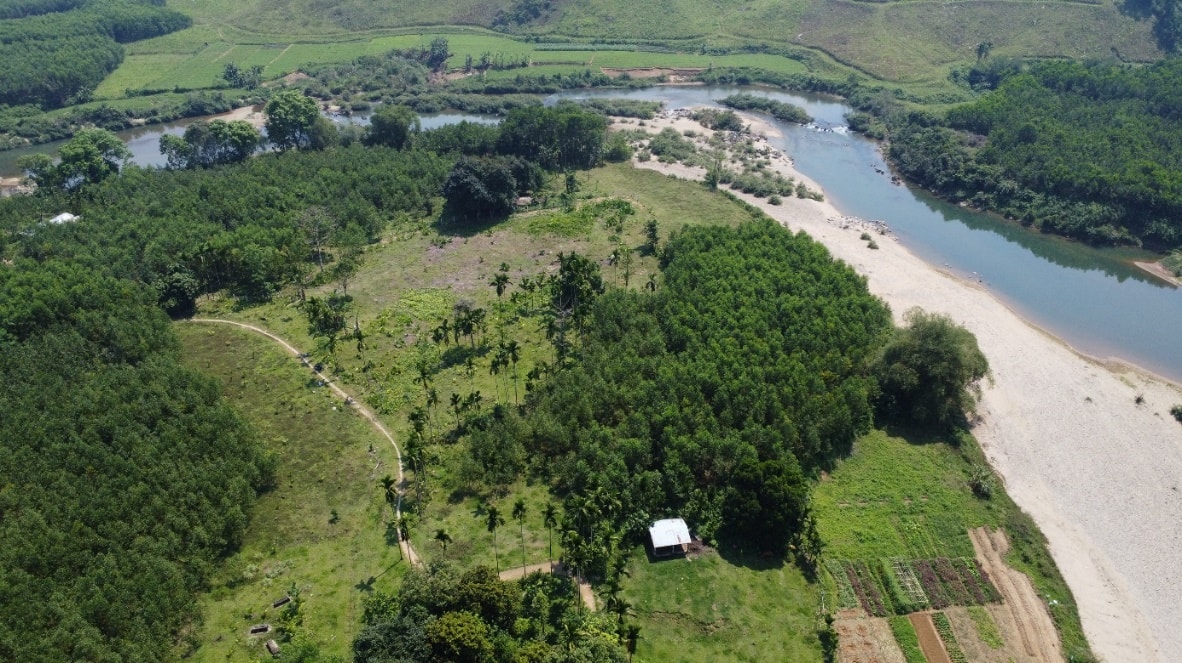
Furthermore, according to Ms. Ho Thi Phien from Hamlet 5, Ba Xa, a few years ago, while picking wild vegetables, she discovered a ceramic jar, about 1 meter tall, that had collapsed right beside a forest trail in the Ong Cho hill area. However, the jar was later dug up by locals, so it is unknown what was inside.
Following the Tra River downstream, in the former Hiep Duc district, we previously discovered a bronze drum at Khe Lanh Anh (now part of Song Tra commune, formerly part of Hamlet 1B, Phuoc Tra commune, hence often called Phuoc Tra bronze drum). This area is currently planted with acacia trees and also has great potential for archaeological excavation to learn more about the Sa Huynh culture in the mountainous region of Quang Nam.
In the lower section of the Tra River, in the Truong River area where the Tra and Tranh rivers meet, in Hiep Hoa and Hiep Thuan communes and Tan Binh town of Hiep Duc district, a survey along the river has uncovered 14 new sites with traces of Sa Huynh culture.
To further verify this, in May and June 2024, the Quang Nam Museum conducted an archaeological survey at the Tho Chua site in Hiep Hoa commune, Hiep Duc district. The results of the 21m2 excavation revealed traces of one earthen tomb, one jar tomb, and two urn tombs with numerous burial artifacts and other signs of habitation.
In Dong Giang district, the Sa Huynh culture was first recorded in the strip of land next to an upstream branch of the Vu Gia River. The river in this area is called the Pa Con River, located in Cho Net village, A Ting commune.
According to local residents, about 20 years ago, while cultivating a plot of land next to the Pa Con River, people discovered an area with many ceramic jars containing agate beads. Because agate is a favorite ornament of the Co Tu people, the locals dug up and destroyed many of the ceramic jars.
Potential for new research
To date, most Sa Huynh cultural sites in the upper reaches of the Thu Bon River and its tributaries have not been fully and comprehensively excavated and archaeologically studied.
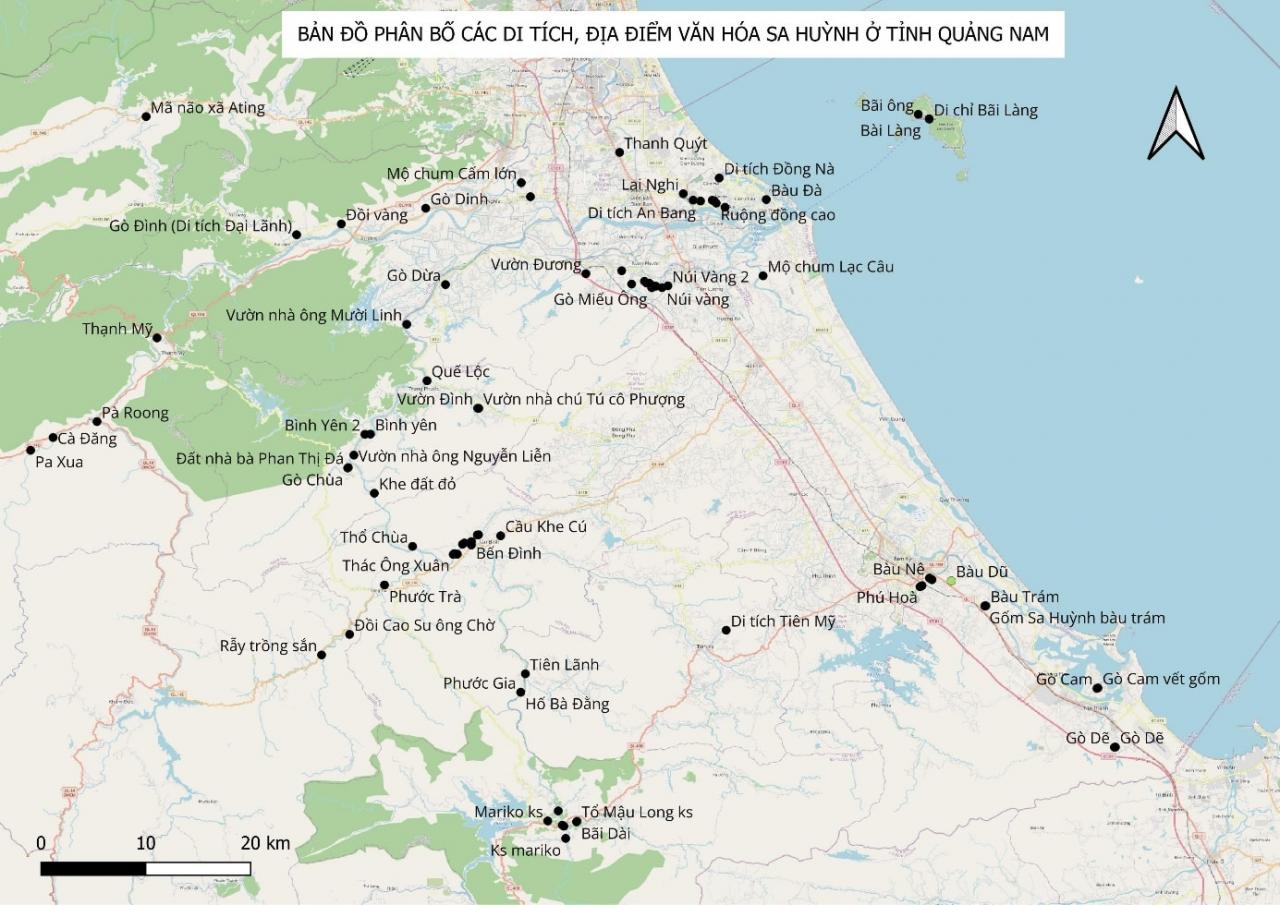
However, the discovered traces of Sa Huynh culture show that the Sa Huynh culture sites are quite densely distributed in the mountainous areas of Quang Nam, concentrated on mounds and flat areas along both banks of the river.
Commonly found at these locations are large, cylindrical jars containing various bronze and iron artifacts, as well as jewelry made of agate, glass, and terracotta.
This research contributes to new insights into the Sa Huynh culture and reflects, in part, the thinking and beliefs of ancient inhabitants regarding the selection of residential areas and burial sites.
They may have used the bends in the river channels as a way to mark the burial sites. The river basins, with their favorable natural geographical conditions, attracted the settlement and habitation of ancient peoples.
The discovery of these new archaeological sites and distribution patterns will make a significant contribution to future research on the Sa Huynh culture in Quang Nam in particular and the central region of Vietnam in general.
Source: https://baoquangnam.vn/tu-dia-van-hoa-nghi-ve-sa-huynh-3143358.html

![[Photo] Prime Minister Pham Minh Chinh holds a phone call with the CEO of Russia's Rosatom Corporation.](/_next/image?url=https%3A%2F%2Fvphoto.vietnam.vn%2Fthumb%2F1200x675%2Fvietnam%2Fresource%2FIMAGE%2F2025%2F12%2F11%2F1765464552365_dsc-5295-jpg.webp&w=3840&q=75)

![[Photo] Closing Ceremony of the 10th Session of the 15th National Assembly](/_next/image?url=https%3A%2F%2Fvphoto.vietnam.vn%2Fthumb%2F1200x675%2Fvietnam%2Fresource%2FIMAGE%2F2025%2F12%2F11%2F1765448959967_image-1437-jpg.webp&w=3840&q=75)































![[OFFICIAL] MISA GROUP ANNOUNCES ITS PIONEERING BRAND POSITIONING IN BUILDING AGENTIC AI FOR BUSINESSES, HOUSEHOLDS, AND THE GOVERNMENT](https://vphoto.vietnam.vn/thumb/402x226/vietnam/resource/IMAGE/2025/12/11/1765444754256_agentic-ai_postfb-scaled.png)









































Comment (0)