

In Dong Nai, taking advantage of the readily available local fish resources, farmers in Lam San commune (Cam My district, Dong Nai province) are using IOM bio-fertilizer, raising earthworms, and persistently cultivating organic pepper.
Secrets to caring for organic pepper plants.
From a particularly disadvantaged commune with limited transportation, but thanks to the efforts of the local government and the unity of the people, Lam San commune (Cam My district, Dong Nai province) has now transformed, putting on a new look. Inter-hamlet roads have been concreted, people's incomes have improved, and it has become a model new rural commune.
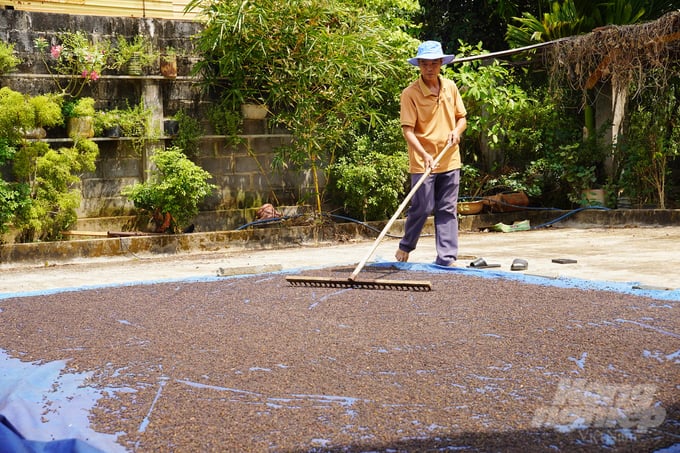
Many farmers in Lam San commune (Cam My district, Dong Nai province) are persistently cultivating pepper using organic methods. Photo: Nguyen Thuy.
According to Mr. Truong Dinh Ba, Chairman of the Farmers' Association of Lam San commune, many years ago, pepper cultivation brought good income to local people. However, recently, due to the impact of climate change, increased fertilizer costs, and falling pepper prices, many households are no longer interested in growing pepper.
However, thanks to the attention of the leaders of Dong Nai province, district, and commune, although the area planted with pepper has decreased, it remains the main crop for the people of Lam San commune. In addition to the area planted with pepper using traditional methods, Lam San commune also encourages the cultivation of clean and organic pepper, meeting increasingly stringent standards for quality, food safety, and pesticide residue-free conditions.
Local farmers have been innovative, researching and learning effective methods and models for caring for crops and livestock to achieve high productivity and quality, reduce costs, and adapt to climate change. In particular, the households in the Lam San Pepper Cooperative deserve special mention.
Initially, 32 members of the cooperative registered to participate in the transition to organic pepper cultivation, but this number later decreased to 16 households, and currently, the Lam San Pepper Cooperative has only a handful of households remaining committed to growing organic pepper.
With encouragement from the local authorities, Mr. Mai Dac Truong (Hamlet 4, Lam San Commune) started switching to organic pepper cultivation in 2019 and has been doing so until now, covering an area of nearly 4,000 square meters, including 600 pepper plants.
When the conversion began, the pepper plants did not yield well and were heavily affected by pests and diseases, causing Mr. Truong and many other households to worry. However, through training courses and guidance from the agricultural sector and the Farmers' Association of the commune, Mr. Truong and the members of the Lam San Pepper Cooperative gradually grasped the technical process and successfully cultivated organic pepper plants.
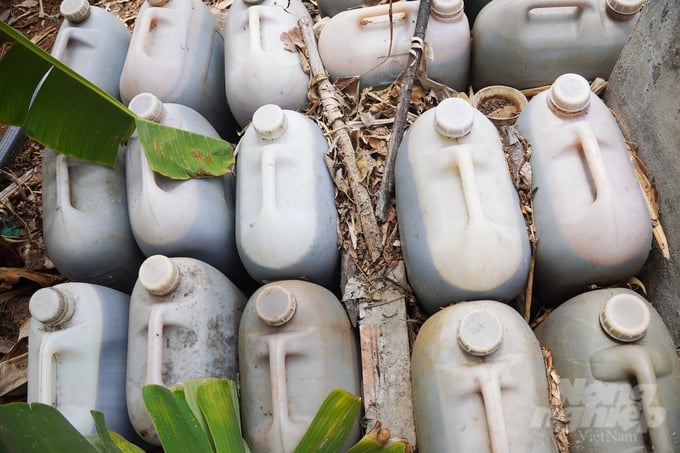
These barrels of fish emulsion are fermented by farmers in Cam My commune using scrap fish as fertilizer for their crops. Photo: Nguyen Thuy.
Mr. Truong said that previously, when using chemical fertilizers, pepper yields were unstable, sometimes high, sometimes low. Since switching to organic farming, the pepper plants have become more vigorous, yields are stable, and costs for fertilizers and pesticides have been saved. "My house is near the pepper garden, so switching to organic farming gives me more peace of mind. It ensures the health of the plants, is good for the environment, and ensures the health of my family," Mr. Truong said.
As one of the pioneers of organic farming in Lam San, Mr. Truong Dinh Ba cultivates various crops in a mixed-crop system on his 2-hectare plot, with 90% dedicated to pepper, entirely using organic farming methods without any chemicals or pesticides.
One of the secrets to achieving high yields and reducing costs for organic pepper cultivation, which Mr. Truong, Mr. Ba, and other organic pepper growers in Lam San commune confidently practice, is utilizing the trash fish in the Song Ray reservoir to ferment microorganisms into IMO fertilizer for the plants.
"Previously, we had to spend money buying starter cultures to ferment fish protein, but now we have become self-sufficient in native biological cultures, the quality is no different from what we buy from companies, but the cost is lower."
After a period of development, we have also introduced many products that can be stored for a long time, such as dry probiotics; and indigenous probiotics fermented with chili peppers, garlic, and ginger to create biological plant protection products to control pests on pepper plants as well as other crops,” said Mr. Truong Dinh Ba.
According to Mr. Ba, every year he and several other households purchase about 1.5 tons of trash fish, producing about 1,000 - 1,500 liters of fish protein to prepare for the next planting season.
Leading us to the backyard where Mr. Ba was fermenting IMO, we were surprised to find there was absolutely no foul odor because he had processed the mixed fish with probiotics using the correct technique. “At first, when we started fermenting fish, many people said we were crazy, that it would smell terrible. But then, they changed their minds and even ordered our fish protein to fertilize their plants,” Mr. Ba said, laughing as he stirred the fermented fish protein in the tank.
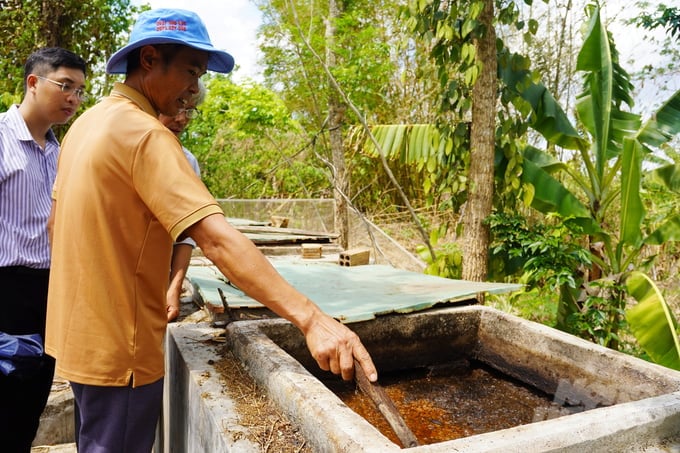
Mixed fish fermented with probiotics to create IMO (Indigenous Microorganisms) is a source of organic fertilizer that provides high nutritional value to plants. Photo: Nguyen Thuy.
Seeing me standing and looking at the goat pen not far away, Mr. Ba further explained: "Our organic farming method combines organic farming with circular agriculture, creating a circular ecosystem." Besides growing pepper, Mr. Ba also raises about 100 chickens and ducks, and 20 goats. To feed the goats, he utilizes cotton poles (planting cotton trees for the pepper plants to cling to), then uses the goat and chicken manure to raise earthworms, and the earthworm castings are used to fertilize the pepper plants. It's a complete cycle; nothing in the garden goes to waste.
Organic farming requires perseverance.
"The most important thing in the transition to organic production is willpower and perseverance. Once you understand the meaning and nature of organic farming, production will be easier. In the future, we will encourage more households with a passion for organic agriculture to gradually make the transition."
"Once farmers understand the benefits of organic farming, they will like it and be willing to persevere in implementing it. The most important thing when doing organic farming is not to be impatient, but to be persistent," said Mr. Truong Dinh Ba, affirming that, in his role as Chairman of the Farmers' Association of Lam San commune, he and the members will regularly disseminate information, encourage, and analyze to help people minimize the use of chemical fertilizers and pesticides on crops, and increase the area of organic farming in the commune.
To help farmers master organic farming techniques, the Lam San Pepper Cooperative established an on-farm monitoring group. Through this, experienced farmers can share knowledge with each other and conduct cross-monitoring to collectively strive towards achieving organic pepper certification and exporting to various markets around the world .
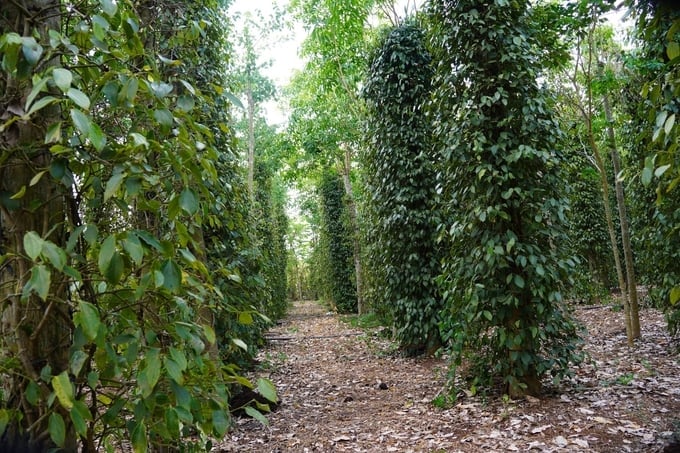
Organic farming helps keep the soil fertile, and the pepper plants remain green, healthy, and strong. Photo: Nguyen Thuy.
However, to ensure high profits for small-scale organic farmers and to encourage other households in the area to readily switch to organic farming, Mr. Bá believes that the government, local authorities, cooperatives, and businesses need to pay more attention and provide appropriate support mechanisms and policies. This will help farmers feel secure and persistent in their cultivation, enhance the brand and value of organic pepper, ensure that the products produced are free of chemical residues, protect the health of consumers and producers, and create a clean living environment.
Currently, Lam San commune only has about 1,100 hectares of pepper plantations, of which only about 16 hectares have been converted to organic pepper production, which is still very low compared to the local potential.
Developing organic and high-tech agricultural production is identified by Dong Nai province as one of its key breakthrough tasks. Specifically, Dong Nai prioritizes the development of high-tech and organic agriculture linked to processing industries and product markets. The goal is to develop high-value, sustainable, and environmentally friendly organic agricultural production, contributing to stable livelihoods and increased income for producers.
Source: https://nongsanviet.nongnghiep.vn/u-che-pham-imo-nuoi-trun-que-kien-tri-trong-ho-tieu-huu-co-d386742.html












![Major policy decisions for agricultural development in Thanh Hoa: [Part 2] Building water reservoirs for the future](https://vphoto.vietnam.vn/thumb/402x226/vietnam/resource/IMAGE/2025/12/14/1765679409826_z7282518628489_e53ef9fd8c182096bda23471d91bbdf1-nongnghiep-172014.jpeg)

























































Comment (0)