

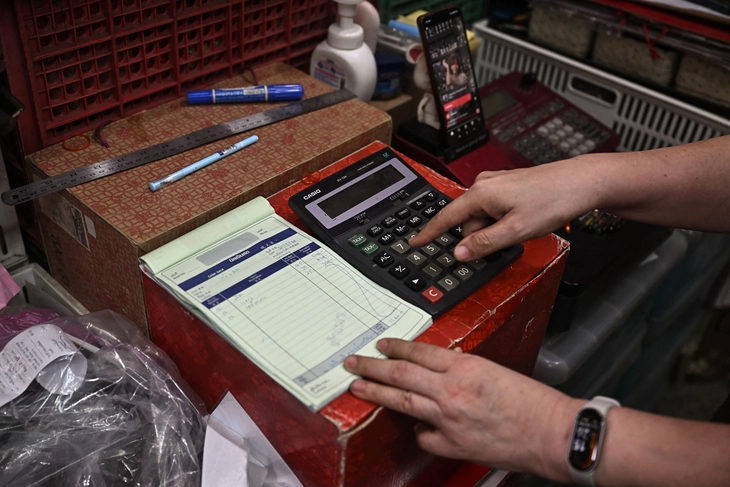
Many traders prefer handheld computers because of their durability and lack of language barriers - Photo: AFP
In Japan and many other Asian countries, the demand for this device has not disappeared. Advantages such as absolute accuracy, low price and the ability to operate without the Internet are helping handheld computers maintain their appeal in the era of strong digitalization.
Live healthy with stability and convenience
According to AFP news agency, Casio - a famous Japanese calculator manufacturer - still sells tens of millions of products each year and is even considering expanding its business in some markets.
Although AI models have achieved high results at the International Mathematical Olympiad (IMO) and smartphones are capable of handling complex calculations, chatbots still sometimes… miscalculate simple additions. Meanwhile, "computers always give the right answer," said Tomoaki Sato, head of Casio.
He acknowledged that the market for business PCs was shrinking, but stressed that the devices were cheaper than phones, easier to buy, easier to use and especially useful in schools in developing countries, which Casio was targeting as a growth market.
In Bangkok (Thailand), many users still choose computers because of the convenience in transactions.
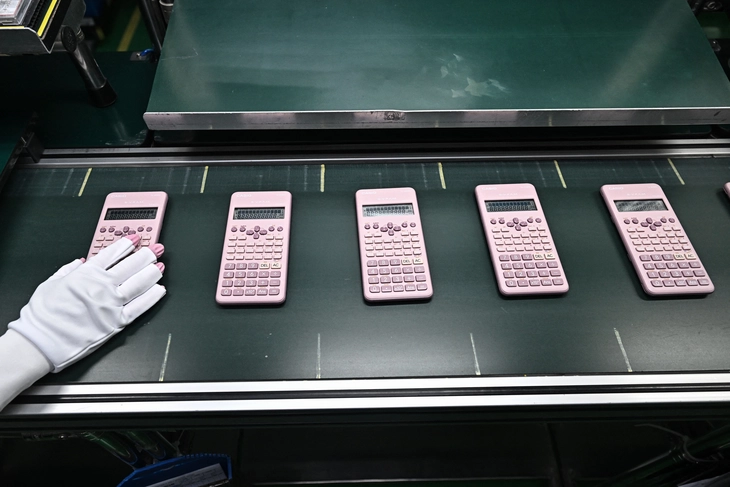
Workers assemble computers at the Casio factory in Nakhon Ratchasima province, Thailand - Photo: AFP
Ms. Thitinan Suntisubpool, a shop owner in Chinatown, said she likes her mainframe computer because it still works despite being dropped many times.
"It's more convenient in many ways," she said, explaining that the computer helps her dial numbers for customers to see directly, avoiding language misunderstandings.
However, sales are not good everywhere: some retailers said the computer market is "quieter" than before.
At the Casio factory in Nakhon Ratchasima (Thailand), workers are still diligently assembling thousands of circuit boards and buttons every day.
Demand for calculators remains steady in places with patchy smartphone connectivity, said Ryohei Saito, head of Casio Thailand. Casio now sells about 39 million calculators a year in 100 countries – down slightly from 45 million before the pandemic, but still holding its global market share.
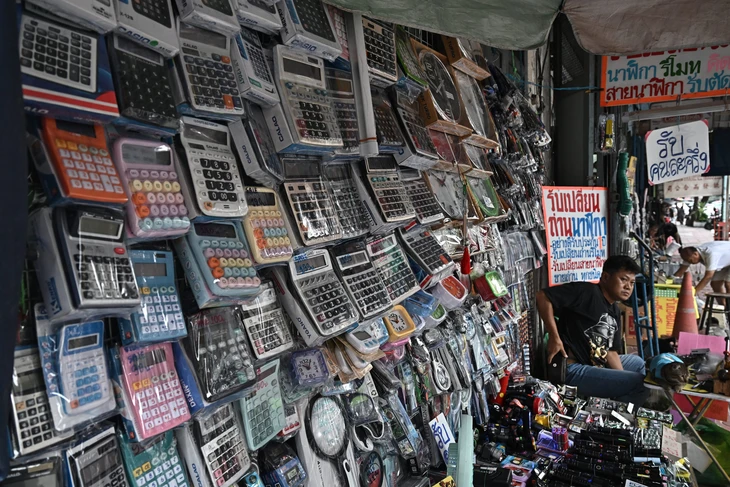
Handheld computers are displayed for sale at a market in Bangkok, Thailand - Photo: AFP
Existing in parallel with AI
The rapid development of AI has raised the question of whether traditional computers are still necessary in life.
This past summer, AI models from Google, OpenAI, and DeepSeek won “gold medals” at the International Mathematical Olympiad—a milestone that shows how rapidly machine learning’s mathematical processing capabilities are advancing.
However, no model achieved a perfect score, while 5 candidates under 20 years old did so.
IMO President Gregor Dolinar said that if asked the right questions, AI could solve abstract problems and provide detailed explanations. He said that physical calculators could “gradually disappear”, as students today mainly calculate using smartphones.
However, the disappearance of computers will not happen quickly. The psychology of simplicity, the need for education , the limitations of digital infrastructure in many countries and long-term usage habits will be factors that help this device continue to exist in parallel with AI in the future.
Source: https://tuoitre.vn/vi-sao-may-tinh-cam-tay-van-song-khoe-du-ai-ngay-cang-thong-minh-20251208120658938.htm

![[Photo] General Secretary To Lam receives the Director of the Academy of Public Administration and National Economy under the President of the Russian Federation](/_next/image?url=https%3A%2F%2Fvphoto.vietnam.vn%2Fthumb%2F1200x675%2Fvietnam%2Fresource%2FIMAGE%2F2025%2F12%2F08%2F1765200203892_a1-bnd-0933-4198-jpg.webp&w=3840&q=75)


































































































Comment (0)