

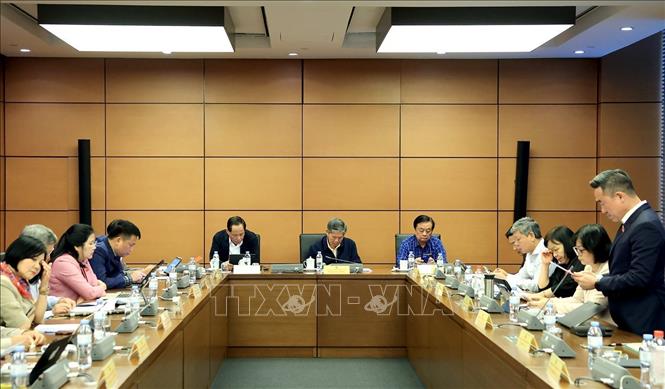
Investing in mainstream multimedia media outlets.
Commenting on regulations related to key multi-media press and media agencies, delegate Tran Hoang Ngan ( Ho Chi Minh City) stated that the revolutionary press of Vietnam has always been closely linked to the cause of national liberation, building and defending the Fatherland. “This is an extremely important means, not only conveying information but also guiding and directing public opinion, contributing to information orientation. The press is also a forum for the people,” delegate Tran Hoang Ngan said.
Delegates analyzed that when soliciting public opinion on draft political reports and draft documents for the 14th Party Congress, the press plays a role in disseminating and spreading information, helping to make the voice of the people a valuable source of data for the Party and the State to formulate policies, strategies, and development plans.
"If we consider journalism as an ideological weapon, the more professional and modern that weapon becomes, the more effective it will be," said delegate Tran Hoang Ngan.
In this new context, the amended law needs to include provisions that align with the development of information technology, multimedia, science and technology, and artificial intelligence, helping people improve their ability to distinguish between true and false information. The role of the Vietnam Journalists Association also needs to be more prominent; at the same time, the responsibilities and scope of state management of localities, as well as the licensing process for journalistic activities, must be clearly defined.
Expressing agreement with the regulation that "A leading multi-media news agency is a media complex operating in multiple forms and services, playing a core role in shaping public opinion, and having a special operating mechanism," delegate Tran Hoang Ngan proposed allowing the establishment of leading multi-media news agencies soon, similar to reputable news agencies around the world.
Sharing the same view, delegate Nguyen Thanh Cam (Dong Thap) suggested specifying the content, criteria, and specific mechanisms and policies to help key multimedia press and media agencies have "ground" to develop and become the pioneering force of the country's press.
"We need to add specific policies for major multimedia media organizations," said delegate Thanh Cam.
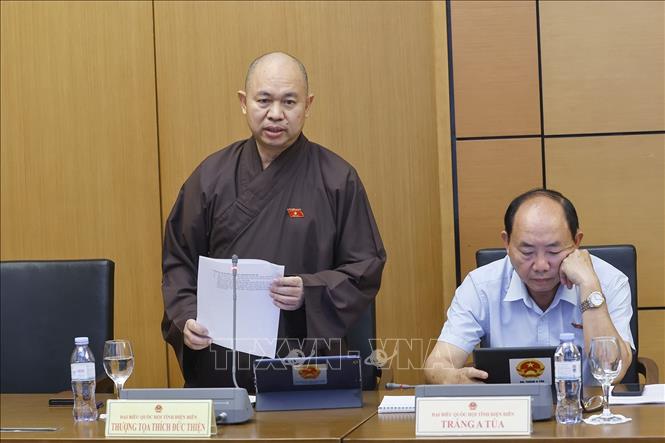
Discussing this issue, Venerable Thich Duc Thien (Dien Bien) stated that, in reality, much fake news, harmful and toxic information still appears on cross-border digital platforms. Therefore, specific and strict regulations are needed regarding commitments and responsibilities for managing journalistic activities in cyberspace, especially for domestic and foreign digital platforms.
"In the context of declining advertising and financial difficulties faced by traditional media, the State needs to continue investing in media outlets, especially key multimedia media organizations, to ensure that the press effectively fulfills its functions of guiding public opinion, communicating policies, and upholding the principles and objectives of revolutionary journalism," Venerable Thich Duc Thien stated.
Clarifying the concept of journalism
During group discussions, delegates expressed strong agreement on the necessity of enacting the amended Press Law to strengthen the management of journalistic activities, improve the quality of journalists, promote the development of the press economy, and regulate journalistic activities in cyberspace in accordance with practical realities.
Commenting on the draft Law, delegate Pham Thi Minh Hue (Can Tho) suggested that the drafting agency clarify the definitions of terms to ensure consistent application and avoid misunderstandings between different types of journalism. The definition of "journalism" should be general, while specific types should be clearly defined separately to avoid duplication.
Furthermore, the content listing journalistic activities needs to be reviewed and supplemented to comprehensively reflect the practical activities of media agencies; some wording should be revised for appropriateness. According to the delegates, the provision stating that "the press has duties and powers" is semantically inaccurate and needs adjustment to align with regulations on the position, functions, and duties of the press; at the same time, the concept of "public service unit" in the regulation stating "media agencies operate as public service units or public service units" needs clarification, as there is currently no specific legal document defining this type.
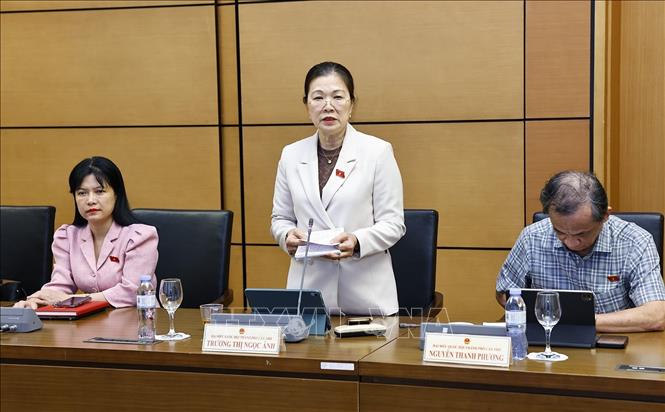
Sharing the same view, delegate Truong Thi Ngoc Anh (Can Tho) suggested that the drafting agency review the definitions of terms, ensuring that the terminology for different types of media is consistent, clear, and appropriate to reality, avoiding the use of "print media" which is inconsistent with other concepts; and to edit concisely, avoiding duplication of content between points and clauses regarding prohibited acts.
Regarding revenue from advertising, sponsorships, or requests for news/articles, Representative Truong Thi Ngoc Anh proposed assigning responsibility to the Government or the Ministry of Culture, Sports and Tourism to provide specific guidelines to limit cases where the press abuses legal regulations and puts pressure on businesses and economic organizations.
Expressing concerns about the regulation granting press cards to journalists who transition to management, teaching, or association work, delegate Truong Thi Ngoc Anh suggested that the drafting agency carefully consider the matter to make the regulation stricter, emphasizing that press cards should be reserved for those directly involved in journalistic work. Granting them to those in other fields could lead to abuse of the card and is inconsistent with regulations on journalistic activities.
Representative Truong Thi Ngoc Anh also proposed separating the two parts – "things journalists must do" and "things journalists are not allowed to do" – to ensure transparency and ease of application. For example, "things that can be done" includes correcting or apologizing in cases of inaccurate or unverified information. "Things that are prohibited" include abusing journalistic credentials to harass, engaging in illegal activities, spreading distorted information, making false accusations, and insulting the reputation and honor of organizations and individuals.
Commenting on the regulations for issuing, renewing, and revoking journalist cards, delegate Ta Thi Yen (Dien Bien) argued that the draft Law's provision requiring those receiving a card for the first time to have at least two years of continuous work experience and "have completed a training course on journalism and professional ethics" organized by the Ministry of Culture, Sports and Tourism in coordination with the Vietnam Journalists Association is not entirely appropriate.
According to the delegates, the regulation's goal of improving the quality of journalists is correct, but considering administrative procedure reform and the government's policy of reducing "sub-licenses and certificates," this regulation is not really necessary.
"Currently, the criteria for granting journalist cards are quite strict. Adding a mandatory requirement to complete professional training and ethical conduct courses before being considered for a journalist card would create a new layer of administrative procedures, essentially a kind of 'sub-license,' generating additional costs, time, and procedures for journalists," Representative Ta Thi Yen stated.
Representative Ta Thi Yen emphasized that from 2021 to the present, the Prime Minister has directed the Ministry of Interior to review and eliminate unnecessary certificates in order to reduce administrative burdens and save social resources. In this context, adding another new certificate – even a training certificate – is unlikely to receive practical consensus. Therefore, Representative Ta Thi Yen suggested that the drafting agency reconsider making this requirement mandatory, instead focusing on updating knowledge and professional ethics through seminars and specialized workshops.
Source: https://baotintuc.vn/thoi-su/cu-the-hoa-noi-ham-co-che-dac-thu-cua-co-quan-truyen-thong-chu-luc-da-phuong-tien-20251023181720945.htm




























































Comment (0)