

However, making English the second language in schools cannot set the goal of Hanoi and Ho Chi Minh City to be like Lao Cai, Lai Chau...
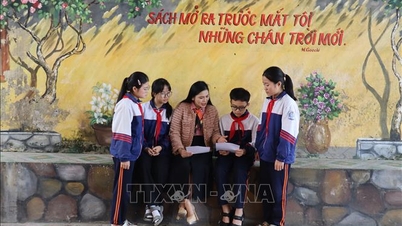
Two years ago, Ms. Nguyen Thi Bich Thu, an English teacher at Nguyen Du Secondary School ( Yen Bai Ward, Lao Cai Province) was one of dozens of teachers assigned by the Provincial People's Committee to teach English to primary school students in Mu Cang Chai. Those were the first years when English became compulsory from grade 3 while many mountainous schools were "empty" of teachers for this subject. Although recruitment announcements were made, no one applied.
Although we were seconded, there were not enough teachers to teach at each school, so we had to teach at several schools in a combination of face-to-face and online teaching. Ms. Thu confided: "It is impossible to tell all the difficulties and hardships, but every day we have to encourage each other to look at the disadvantages and the desire to learn of the students here to try to overcome them."
The local government here also has high expectations for students to learn English to develop tourism because Mu Cang Chai is a famous place that many domestic and foreign tourists visit. They only set the goal that after graduating from high school, students can communicate in English, and have never dared to dream that they will be able to learn other subjects in English.
To carry out the determination, which is also the political task set out by the General Education Program, they have tried every way, including sending teachers from urban areas to remote areas, requiring one teacher to teach in many schools with many different forms... However, more than anyone else, they understand that these are only very short-term solutions, "fire-fighting" in nature for each school year.
The draft National Target Program on Modernization and Improvement of Education and Training Quality for the 2026-2035 period sets a target that by 2030, at least 30% of preschool and general education institutions will gradually make English the second language in schools. However, many opinions are concerned that if applied uniformly to all provinces and cities across the country without distinguishing between socio-economic conditions, infrastructure and teacher resources, the possibility of achieving this goal will be very low and reduce the effectiveness of the policy.
Therefore, there is an opinion that even though it is a "second language", it should not be implemented rigidly. In difficult provinces, it is necessary to concentrate resources so that students can learn English effectively first; in large cities, it is necessary to raise the issue of bilingual teaching and learning in English. If the same goal is set, then favorable places may have to wait for difficult places, leading to delayed development and vice versa.
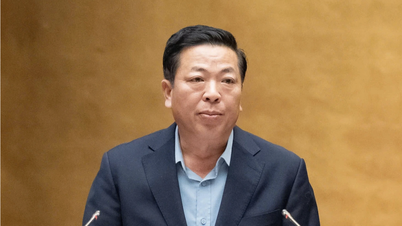
National Assembly delegate Nguyen Thi Lan Anh (Lao Cai province) also proposed adjusting the target for each local group, and at the same time suggested that the Government assign the Ministry of Education and Training to coordinate with relevant ministries to develop a long-term training plan for English teachers in disadvantaged areas with a separate funding source from the central budget to solve the problem of the serious shortage of teachers for this subject for many years.
Only with reasonable decentralization and appropriate mechanisms can the goal of making English the second language in schools be truly feasible and effective in all regions of the country.
Source: https://thanhnien.vn/hoc-tieng-anh-va-hoc-bang-tieng-anh-185251206221123096.htm


![[Photo] General Secretary To Lam receives the Director of the Academy of Public Administration and National Economy under the President of the Russian Federation](/_next/image?url=https%3A%2F%2Fvphoto.vietnam.vn%2Fthumb%2F1200x675%2Fvietnam%2Fresource%2FIMAGE%2F2025%2F12%2F08%2F1765200203892_a1-bnd-0933-4198-jpg.webp&w=3840&q=75)



























































































Comment (0)