

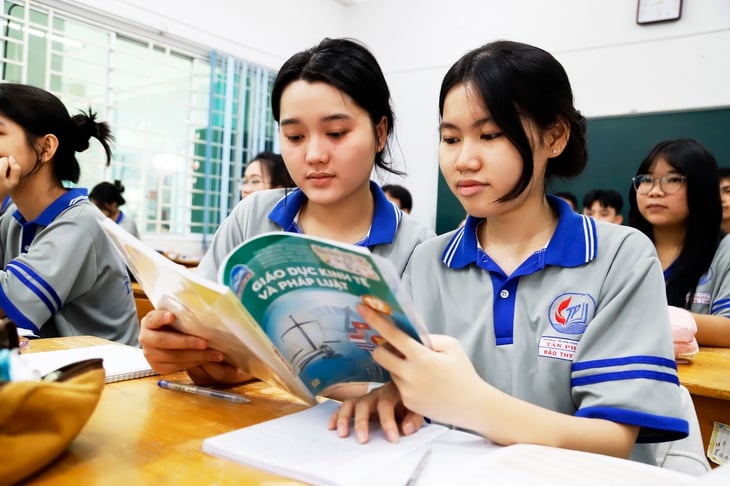
Students must be placed at the center of educational activities. In the photo: a lesson in economics and law education of teachers and students at Tan Phong High School, Tan Hung Ward, Ho Chi Minh City - Photo: NHU HUNG
Editor's note: The Government's report at the discussion session of the National Assembly Standing Committee on December 4 clearly stated that the Minister of Education and Training will decide to compile a new set of textbooks for use nationwide or select and edit from existing books.
How can this work be completed in time for the 2026-2027 school year, while avoiding waste when there are currently three sets of books approved and being used nationwide? Tuoi Tre recorded the opinions of teachers, experts and National Assembly delegates.
* Delegate NGUYEN THI VIET NGA (Deputy Head of the National Assembly Delegation of Hai Phong City):
Must be truly for the learner
The most important point when compiling a unified set of textbooks is that it must be truly for the students, not for group interests or administrative convenience. In particular, we must focus on reducing the curriculum to make it more suitable and closer to students.
To have the best solution, three points need to be focused on.
Firstly, the unified set of textbooks should be "selected" from textbooks that are being used effectively. Instead of compiling completely new ones, the Ministry of Education and Training should organize an independent assessment of all current textbooks. At the same time, select the best books from each set to form a national standard textbook set; adjust to unify the structure, knowledge framework, and output standards.
This approach saves time and money while leveraging the wisdom of many teams of authors who have been tested in practice.
The editorial team must have a harmonious combination of prestigious, highly specialized experts and scientists with experienced teachers, in order to create textbooks that are close to and suitable for the psychology, age, and learning ability of students.
Second, the handling of existing textbooks is also an issue that needs to be resolved appropriately. We support the policy of ensuring the provision of a unified set of textbooks nationwide, but we should not immediately eliminate the three current general textbooks because these sets of books have also been carefully compiled, rigorously assessed, and scientifically. If we eliminate them, it will be a waste.
Therefore, along with a common set of standard textbooks, schools, teachers and students need to consider these textbooks as useful reference materials to contribute to diversifying knowledge and improving the quality of teaching and learning. However, there should be close and appropriate management measures to avoid the abuse of reference books, which can easily create unnecessary pressure on students as has happened in the past.
Third, requirements must be set to avoid re-establishing monopoly. If the Ministry of Education and Training compiles textbooks without a strict monitoring mechanism, it is easy to return to the old model. Therefore, it is necessary to ensure an independent appraisal council, and to make the entire selection, appraisal, and pricing process transparent. At the same time, "state management" and "compilation organization" must be separated; the unified price of textbooks by the Ministry must be set by the State to avoid cost overruns.
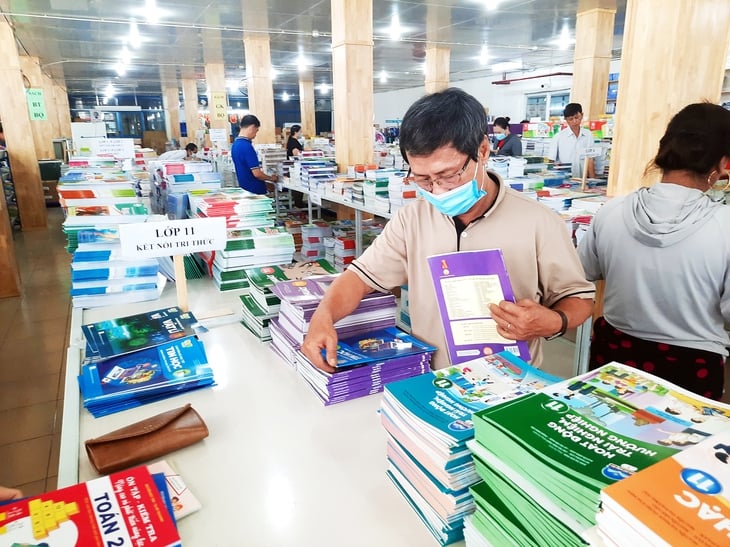
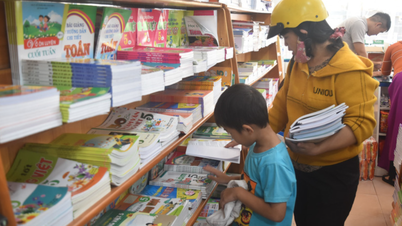
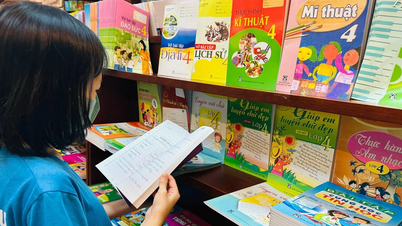
Parents buy textbooks for students to prepare for the new school year at Ho Chi Minh City Books and School Equipment Joint Stock Company - Photo: ANH KHOI
* National Assembly Delegate VU HONG LUYEN (Hung Yen)
Should choose according to each level of study
Regarding the content related to organizing a unified set of textbooks, opinions are focusing on the following three basic options: 1. Organizing the compilation of a completely new set of textbooks; 2. Choosing one of the three existing textbook sets as a common set; 3. Choosing a unified set of textbooks by grade level based on the three current textbook sets.
Each option has its own advantages and limitations and needs to be discussed and carefully considered. Through research on practical implementation and absorbing the opinions of many experts, I believe that the option of choosing a unified set of textbooks for each level of education is a reasonable and feasible option that fully meets the requirements of the law as well as the major orientations of the Party and State as expressed in the Constitution, resolutions of the Politburo, the Government and the National Assembly.
Firstly, this solution ensures continuity, efficiency, savings and prevents waste. Using a common set of books for each grade level helps to overcome the situation of constant change and conversion, which is costly for families, schools and the education system itself.
Second, the plan of a unified set of textbooks ensures consistency throughout the system. When the goals and requirements of the general education program are conveyed uniformly through a set of textbooks at each level, teachers will have a solid basis for implementing teaching methods; students will have access to consistent content; and schools will have less pressure to choose, avoiding the situation of "each person choosing for themselves" causing a quality gap between localities.
At the same time, in each complete set of books from any publisher, the content and teaching methods have been designed in a synchronous and consistent manner, thereby improving the effectiveness of program implementation.
Third, this is a solution to ensure fairness between organizations, individuals and subjects. The textbooks that have been assessed and approved have the opportunity to be selected at at least one level of education, in line with the spirit of encouraging socialization of Resolution 88. Enterprises, especially private enterprises, have invested large resources in compilation work, will not fall into a situation of losing all capital leading to the risk of bankruptcy.
At the same time, this method also avoids the situation of distinguishing between main and secondary subjects or the situation where some subjects have books that can be chosen at all levels while other subjects cannot have any books chosen; or distinguishing between subjects with exams and subjects without exams, subjects with many periods and subjects with few periods.
Another important thing is that the plan for a unified set of textbooks by grade level helps to increase convenience and efficiency in state management of education. The Ministry of Education and Training does not have to organize the appraisal and selection of too many books, and at the same time, the work of directing, guiding and training teachers will be more scientific, focused and effective, because each set of books is associated with a clear and unified compilation unit.
5 recommendations from a teacher
Firstly, it is necessary to invite teachers who directly teach to join the textbook compilation team. In addition to leading professors, doctors and prestigious education experts, the participation of high school teachers in the book compilation process is very necessary. Because teachers are the ones who directly teach in the classroom, thoroughly understand the practical education and understand the difficulties of teaching in high school.
Second, create "openness" in textbooks. Textbooks are no longer a law but a teaching material to implement the educational program issued by the Ministry of Education and Training. Therefore, in addition to the unified and standardized set of books compiled by the Ministry, there is still a need for reference books so that teachers can proactively choose appropriate materials, flexibly use methods to approach knowledge and hone their capacity.
Third, focus on training teachers immediately after the unified set of books is completed. Fourth, build an open digital learning resource warehouse associated with modern technology, integrating artificial intelligence. This will be a virtual connection channel to help teachers feel secure in learning, training, researching and creating in the face of constantly changing educational practices.
Fifth, distill the essence of current textbooks. "Connecting knowledge with life", "Kite", "Creative horizon" are three textbooks that have been painstakingly researched and compiled by many groups of authors and have been assessed for quality by the Ministry of Education and Training. The Ministry of Education and Training needs to evaluate the advantages and disadvantages of each textbook, discover the bright spots and inherit the good, progressive, and positive things so that the unified textbook set can be completed soon.
Thanh Nguyen (teacher in Hue)
Source: https://tuoitre.vn/mot-bo-sach-giao-khoa-thong-nhat-ca-nuoc-lam-sao-de-kip-tien-do-tranh-lang-phi-20251208084900151.htm

![[Photo] General Secretary To Lam receives the Director of the Academy of Public Administration and National Economy under the President of the Russian Federation](/_next/image?url=https%3A%2F%2Fvphoto.vietnam.vn%2Fthumb%2F1200x675%2Fvietnam%2Fresource%2FIMAGE%2F2025%2F12%2F08%2F1765200203892_a1-bnd-0933-4198-jpg.webp&w=3840&q=75)









































































Comment (0)