

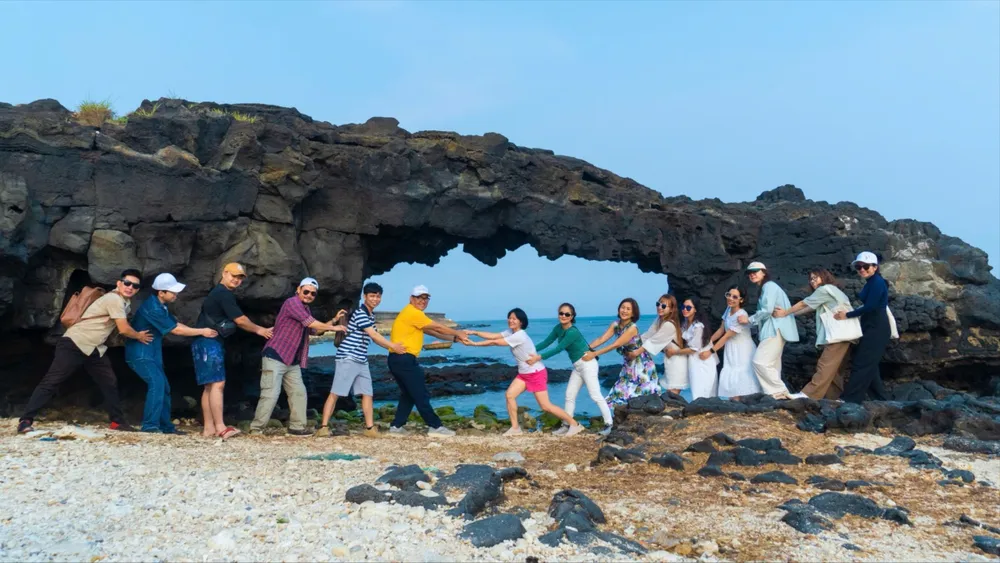
According to the decision signed on September 9, 2025, the protected area for the historical site is determined according to the minutes and maps outlining the protected areas in the dossier.
The People's Committees at all levels in the localities where the classified relics are located shall, within their duties and powers, exercise state management over the relics in accordance with the law on cultural heritage.
The Tò Vò Arch scenic spot was formed from the volcanic eruption of Giếng Tiền (Lý Sơn), creating a thick layer of basalt at the Tò Vò Arch location. Over time, the basalt layer at Tò Vò Arch was broken and eroded by sea waves due to the process of sea level rise, breaking into the middle layer of rock which has weaker cohesion than the layer above, creating a hollow, hollow space resembling a rock arch shaped like a wasp nest.
Its pristine, unique, distinctive beauty and high recognition make the To Vo Archway one of the most famous landmarks in Quang Ngai province and Vietnam.
Located within the maritime cultural space, alongside tangible cultural heritage values (Gieng Tien volcano, Duc Pagoda, Cau Cave, Thoi Loi mountain, Xo La well, An Hai village communal house, Am Linh Temple, Whale skeleton exhibition house, Hoang Sa and Bac Hai naval fleet exhibition house, Be Island area...), intangible cultural heritage values are linked to the traces and cultural transformations of three layers of inhabitants: Sa Huynh - Champa - Dai Viet, the history of protecting national sovereignty over the sea and islands, folk knowledge about traditional crafts (onion and garlic cultivation, net weaving), folk knowledge about cuisine, folk performing arts, Han Nom documents, etc.
At the same time, the sea area of Ly Son in general and the To Vo Arch scenic area in particular provide a favorable environment for the development of seagrasses and coral reefs, creating abundant marine resources and providing livelihoods and the main source of income for the majority of the island's population.
The To Vo Archway scenic spot possesses a full range of historical, cultural, scientific, aesthetic, tourism, and economic values. Therefore, it is an important infrastructure and a driving force for the economic, tourism, and cultural development of Quang Ngai province and the whole country.
Source: https://www.sggp.org.vn/thang-canh-cong-to-vo-dac-khu-ly-son-duoc-xep-hang-di-tich-quoc-gia-post812339.html








![[Video] Hue and Quang Ninh mark strong tourism growth](https://vphoto.vietnam.vn/thumb/402x226/vietnam/resource/IMAGE/2025/12/12/1765555481742_dung00-22-16-02still007-jpg.webp)























































Comment (0)