

Tan Phuc commune (Nong Cong district) is a land with a rich historical and cultural tradition closely linked to the thousand-year history of the nation. The people here are always proud of their many significant historical sites, including two: the Vo Uy temple in Ngoc Uyen village and the Le Hiem - Le Hieu temple in Thai Son village, both recognized as national historical and cultural relics.
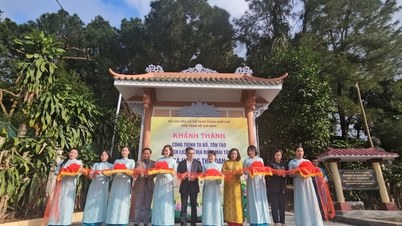
 The Vo Uy temple is located in Ngoc Uyen village, Tan Phuc commune (Nong Cong district).
Like many other villages, Tan Phuc still has many temples dedicated to meritorious officials who contributed to the homeland and the country, most notably those from the Le Dynasty. Prominent among them are Vo Uy, Le Hiem, and Le Hieu, who were founding heroes of the Later Le Dynasty. At the Vo Uy temple, the temple's historical records clearly state: After the Lung Nhai oath ceremony, Le Loi appointed civil and military generals. Among them, Vo Uy, in addition to being a vanguard general and a high-ranking military commander, also served as a logistics general, dividing his efforts to lead the army in an offensive against the enemy. In the year Giap Thin (1424), Vo Uy, obeying the orders of Emperor Le Loi, led the army in an offensive against the Ming army, sending troops ahead to break through the Tran Nang battle (Bat Mot - Thuong Xuan), capturing their general, and then pursuing them to the districts of Thuy Nguyen (Yen Dinh, Thieu Hoa), Nong Cong, and Loi Duong (Tho Xuan).
In the battle against the Ming army at Thuan Thien - An Dinh in 1424, he bravely sacrificed his life. Vo Uy rendered great service to the court and was bestowed the title of Heroic Marquis of Kha Lam by King Le Loi for his assistance in national affairs. Later, he was promoted to the rank of Lieutenant Truong Quoc Cong, and was granted the royal surname Le (the surname of King Le Loi). Vo Uy was one of the 12 meritorious officials who died on the battlefield and were buried at Lam Son along with Le Lai; later, his descendants moved his tomb to Da Cang, Nong Cong. In remembrance of the renowned general Vo Uy, after his death, the people of the villages all erected altars in his honor; however, currently, the only remaining temple dedicated to Vo Uy is in Ngoc Uyen village.
Mr. Nguyen Huu Chinh, head of Ngoc Uyen village and head of the management board of the Vo Uy Temple relic site, said: The temple was built around the 16th century on an area of 450 square meters, with a five-bay structure, built in the traditional wooden house architectural style. The Vo Uy Temple was recognized as a national historical and cultural relic in 1996. However, over time, war, and fierce bombing have caused serious deterioration of the temple, with the entire roof cracked and leaking, and some wooden components damaged by termites... With the attention of all levels and sectors, since 2019, along with the budget of the province and district, Tan Phuc commune has mobilized local people as well as descendants from all over the country to contribute to the restoration of the temple. After two years of social mobilization, the temple has been restored with many items such as dismantling the entire roof; replacing the entire main door; repairing and restoring the windbreaks, lintels, and lim wood; laying tiles, raising the foundation; Renovating the campus... with a total budget of 1.3 billion VND.
Along with the Vo Uy temple, the Le Hiem - Le Hieu temple is also a source of pride for the local people. The temple was recognized as a national historical and cultural relic in 1994. The temple's historical records clearly state: Le Hiem, born in 1392 in Thieu Thien district, Ngoc Lac county, was a talented general who excelled in battles against the Ming invaders by the Lam Son army. He died in the year Quy Mui (1463) at the age of 72, and was given the posthumous name Trung Dinh by the king and bestowed the title of Supreme Blessed God Great King.
Duke Le Hieu, the only son of Le Hiem, was one of the 18 patriots who participated in the Lung Nhai Oath Ceremony. Le Hiem and his son Le Hieu participated in many major battles, the most memorable being the ambush at Chi Lang on September 20th, 1427 (the year of Dinh Mui), where they beheaded General Lieu Thang at Ma Yen; and the sweep at Pho Cat, where they captured 50,000 enemy soldiers, beheaded Deputy General Luong Minh, and forced Minister Ly Khanh to hang himself. Continuing the tradition of his ancestors, Grand Tutor Le Phu, the sixth son of Le Hieu, on August 1st, 1552 (the year of Nham Ngo), during the coup d'état led by Mac Dang Dung to overthrow the Le dynasty, despite being nearly 80 years old, he joined the court officials in suppressing the coup. He and his seven sons participated in the government, contributing to the building and consolidation of the Le dynasty.
For their immense contributions to the country, the father, son, and grandson of Le Hiem, Le Hieu, and Le Phu were granted numerous royal decrees by various dynasties. Le Hiem received 7 decrees from the Le dynasty and 3 from the Nguyen dynasty; Le Hieu received 5 from the Le dynasty and 3 from the Nguyen dynasty; and Le Phu received 7 decrees and a silk portrait from the Nguyen dynasty. The temple was built in a grand style, but due to various reasons, it has deteriorated over time. However, in the early spring of 2024, joy came to the local government and people when they received Document No. 4613-CV/VPTU from the Provincial Party Committee regarding the approval of the investment plan and design for the restoration and preservation of the Le Hiem - Le Hieu temple in Tan Phuc commune (Nong Cong district).
Mr. Nguyen Huu Bich, Secretary of the Party Committee of Tan Phuc commune, said: “Over the years, thanks to the attention of all levels and sectors and the joint contributions of generations of people in the commune, these temples have been and are being renovated with many items to be worthy of a national-level historical site. Hopefully, this will be a place not only for spiritual and cultural activities but also a bond connecting the cultural community of the village, thereby working together to build a more prosperous Tan Phuc homeland.”
Text and photos: Trung Hieu
(This article references and uses some content from the book "History of the Party Committee and Revolutionary Movement of Tan Phuc Commune (1930-2013)".
Source














![[Photo] Prime Minister Pham Minh Chinh holds a phone call with the CEO of Russia's Rosatom Corporation.](/_next/image?url=https%3A%2F%2Fvphoto.vietnam.vn%2Fthumb%2F1200x675%2Fvietnam%2Fresource%2FIMAGE%2F2025%2F12%2F11%2F1765464552365_dsc-5295-jpg.webp&w=3840&q=75)










































Comment (0)