

The story of the teacher asking parents for money to buy a personal computer immediately attracted public attention, even though controversies surrounding school contributions at the beginning of the year have long been common.
For a long time, the annual contribution process has been a familiar and well-known tradition. At the beginning of the year, various fees are collected and discussed at parent-teacher meetings, often through the parent-teacher association. While the vast majority of parents secretly disagree, they often reluctantly accept the situation to gain the "voluntary" consent of the entire group. The reason, of course, is obvious to everyone: for the future of their children.
From the annual fee for air conditioners, to the electricity bill for running them, to the projector fee... Recently, some new "types" of contributions have emerged, such as money for cleaning and sweeping the classroom. And most recently, the story of a teacher "negotiating" to get money from parents to buy personal computers at a primary school in Ho Chi Minh City has once again attracted attention.
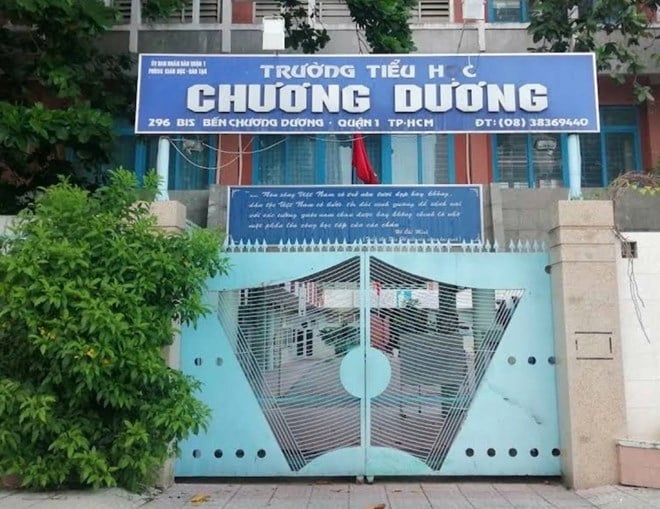
The school where the incident occurred.
Amidst this long-standing absurdity, it seems that "unique and bizarre" stories will not only attract public attention but also amplify accumulated grievances about an inadequate situation that has remained unresolved for many years.
There's an interesting colloquial term: "begging for money." In this context, the beggar places themselves in a superior position, in a "top position," while the person being begged for, or being asked for from, is naturally in a position where they have no choice but to give, or even face coercion.
In this particular story, the teacher asked the parents for permission. Normally, the person being asked has the right to grant or deny the request, to agree or disagree. However, in this context, with their child in the teacher's care, the pressure was immense, causing parents to hesitate to express their opinions frankly, or more accurately, to refuse if they felt it was unreasonable.
The story didn't end there. Immediately after a parent "bravely" refused the offer to contribute money to help the teacher buy the machine, the teacher responded by asking which student's parent they were.
To some extent, this could be seen as a form of "intimidation" or "subtle warning" to "opposing" parents. Furthermore, the teacher continued to demonstrate her attitude by refusing to prepare review materials for the class.
It can be asserted that for many years we have yet to define a clear philosophy or direction for education . As a country heavily influenced by Confucianism, many people still cling to the philosophy of "a single word from a teacher is worth more than half a word from anyone else," and "respecting teachers and valuing morality," almost to the point of being unconditional.
But from another perspective, we have also embraced the view that education is a service industry where learners and their families pay, and therefore they have certain "demands" on educational institutions and even on those directly involved in teaching.
Essentially, teachers are also victims of this "half-hearted" situation. They face considerable pressure to ensure a livelihood for themselves and their families, and a conflict between their income, which is still inadequate according to the established salary scale, and the demands of real life.
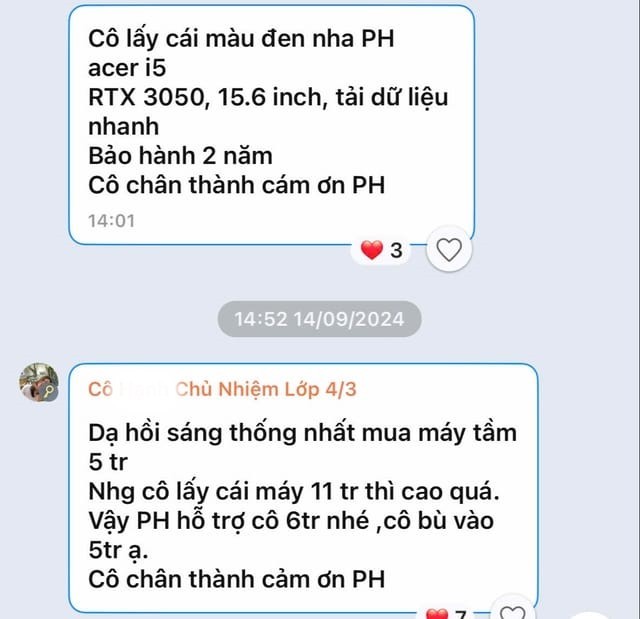
The teacher's message asking for money to buy a computer.
Currently, it is difficult to assert that a teacher, if they adhere to industry regulations, will earn enough to cover their personal and family needs.
In recent developments, contributions to the salary reform agenda have included numerous suggestions to include teachers in the list of highest-paid professions, highlighting current shortcomings.
The problem is that amidst these shortcomings and difficulties, teachers cannot blame the circumstances and then feel entitled to harass parents, or even threaten children in school to some extent.
Ultimately, students don't want tension in their relationships with teachers, and parents certainly don't. Perhaps only when teachers, parents, and society as a whole share a common perspective and each contributes to the cause of educational reform, will real progress and improvement be possible.
Above all, every adult needs to recognize that every action and word we utter serves as an example for future generations to learn from. If we want future generations of Vietnamese people to be good individuals in terms of physical health, mental well-being, and character, everything needs to start today...
Source: https://phunuvietnam.vn/co-giao-xin-tien-mua-may-tinh-and-tam-guong-xau-cho-tre-20240929225818015.htm




















![[Photo] Prime Minister Pham Minh Chinh holds a phone call with the CEO of Russia's Rosatom Corporation.](/_next/image?url=https%3A%2F%2Fvphoto.vietnam.vn%2Fthumb%2F1200x675%2Fvietnam%2Fresource%2FIMAGE%2F2025%2F12%2F11%2F1765464552365_dsc-5295-jpg.webp&w=3840&q=75)













































Comment (0)