

The Provincial Departments and District People's Committees Competitiveness Index (DDCI) of Thanh Hoa province has undergone three evaluation seasons. Each year, the rankings and DDCI scores of the evaluated entities have shifted compared to previous years. However, beyond the expectation of improved governance quality due to the competitive nature of being scored and ranked, the DDCI aims for a higher goal: frankly identifying areas for further reform.
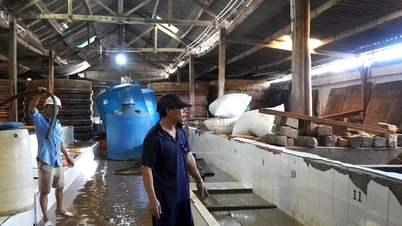
 Production operations at the Long Son Cement Company's Operations Center (Bim Son town).
Key indicators to note
The results of the 2023 DDCI (Provincial Competitiveness Index) for Thanh Hoa province show that the median score of the DDCI index for both the State-owned Enterprises (SOEs) and district-level People's Committees decreased slightly compared to 2022. Specifically, the median score for the SOEs in 2023 was 60.76 points, down 6.04 points from 2022. The median score for the district-level People's Committees in 2023 was 60.99 points, 6.2 points lower than in 2022. Although these decreases are not very large, they indicate that the quality of governance of provincial-level SOEs and district-level governments is somewhat less positive, according to the assessment of the business community.
Specifically, within the SBN group, while scores among units tend to be more balanced and no unit was ranked as "poor," the median score for the entire group decreased, indicating that the scores of units in the upper half of the ranking tended to decline compared to the previous year...
Not only the overall score, but also the median score of the component indicators need to be considered. Accordingly, the State-owned Enterprises (SBN) group recorded a significant decrease in 5 out of 7 indicators compared to 2022; among them, "Dynamism and the role of the leader" and "Transparency and access to information" were the two indicators with the sharpest declines, at -1.04 points and -1.00 points respectively. For the district-level People's Committees, 7 out of 8 indicators decreased in score, with the "Fair competition" indicator experiencing the sharpest decline of -1.75 points; the "Transparency and access to information" indicator also decreased significantly by -1.03 points. This shows that a fair competitive environment among businesses is the aspect that needs the most attention and improvement in the future.
More specifically, the ranking and scores of each component index of the DDCI reveal many "bottlenecks" that the People's Committees and localities recognize and are planning solutions to improve significantly. For example, in the district-level People's Committees, the analysis of the transparency and access to information index shows that, alongside the impressive top 5 with very high scores such as Hoang Hoa district, Sam Son city, Nong Cong district, Dong Son district and Thanh Hoa city, there are 3 units with very low scores and ranked in the "not good" group: Lang Chanh, Muong Lat, and Cam Thuy districts. Several units experienced a significant decrease in this index compared to 2022, including Hau Loc, Nhu Xuan, Quan Hoa, Trieu Son, Vinh Loc, and Nga Son districts, with scores ranging from -1.81 to -1.32 points.
It is known that the Transparency and Access to Information Index for district-level People's Committees is composed of 12 specific indicators across 4 groups of criteria: Effectiveness of the electronic information portal; public disclosure of processes, procedures, and information; evaluation of issued documents; and ease of accessing information. Analysis of the DDCI with this index also showed that, although the average score of the indicators this year was quite high, only 1 out of 12 indicators scored higher than the previous year, while the remaining 11 out of 12 indicators scored lower than the previous year.
Furthermore, regarding the time cost index for district-level People's Committees, the 2023 ranking shows Sam Son City as the leading unit with 8.92 points. Hoang Hoa district is second with 8.76 points. Conversely, Nghi Son town and Muong Lat district are the two units at the bottom of the ranking, with 5.10 and 5.15 points respectively. Notably, this is the second consecutive year that Nghi Son town has ranked last in this index.
In the SBN group, while the top-ranked units scored very high on informal costs, such as the Provincial People's Committee Office with 9.59 points and the Department of Industry and Trade with 8.85 points, some units at the bottom received very low scores, such as the Department of Education and Training with 4.95 points, the Market Management Department with 5.19 points, the Provincial Social Insurance Department with 5.19 points, and the Department of Natural Resources and Environment with 5.73 points...
Also in this index, the constituent indicators quite clearly reflect the situation of businesses having to pay unofficial costs: 26% of businesses responded that they were forced to pay unofficial costs if they wanted their work handled by SBN to go smoothly, a slight increase compared to the 22% rate in 2022. Regarding the criteria group "the prevalence of harassment," 76% of businesses assessed that the phenomenon of causing difficulties for businesses at SBN tended to decrease compared to 2022; however, about 25% of businesses reported that harassment was still common at SBN; notably, in some SBNs, the percentage of businesses reporting harassment still reached 59%.
Towards a more equitable and friendly business environment.
After analyzing and evaluating the 2023 DDCI (Provincial Competitiveness Index), the VCCI Thanh Hoa - Ninh Binh Branch recommends several specific issues within various groups that require more significant improvement.
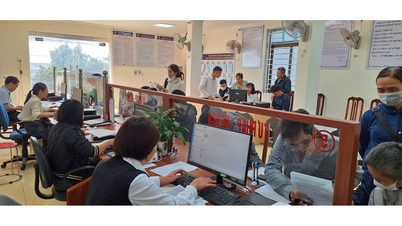
 Civil servants from departments and agencies handle administrative procedures for businesses and citizens at the Thanh Hoa Provincial Public Administrative Service Center.
Accordingly, in both the State Bank of Vietnam and the district-level People's Committees, although the index for supporting businesses has improved in score, it should still be noted that in some localities, the work of receiving citizens and holding regular dialogues with businesses is still not being carried out well. The percentage of businesses invited to participate in business dialogue activities in some localities is still low; at the same time, the business community in some localities still does not highly appreciate the seriousness in handling business requests. These are aspects that some localities need to pay special attention to and improve.
Regarding security and order, Thanh Hoa province generally scored quite well, with no localities scoring below average. However, some localities showed significantly low scores in certain key indicators. In particular, in some areas, only about 71% of businesses stated they "did not have to pay protection fees"; in some localities, only 55% of businesses believed that "paying for protection services or informal social support to ensure peaceful production and business operations is not common." Therefore, localities with low scores in these indicators need to review their security and order practices to ensure businesses can focus on production and business development with peace of mind.
In particular, the issue of land access in localities and the handling of administrative procedures related to land continues to be an area with low scores, with 16 out of 27 localities scoring below average. The difference in scores between the top and bottom groups in this index is also particularly large, partly reflecting the significant differences in topography, population density, and urbanization rates among localities in the province. Therefore, Thanh Hoa province needs to promote specialized and innovative solutions to improve land access for each locality.
Furthermore, aspects related to business harassment and informal costs, while showing slight improvement in some indicators, have fundamentally not seen any breakthrough changes compared to two years ago. Therefore, this continues to be an issue that needs attention. The VCCI Thanh Hoa - Ninh Binh Branch also recommends that further in-depth surveys should be considered to provide a basis for proposing reasonable solutions, especially for some State-owned enterprises and localities with a high rate of negative business complaints. In addition, it is necessary to continue improving business inspections, reducing instances of repeated and prolonged inspections.
Regarding the fair competition index, many units in the province saw a significant drop in scores this year, with 11 out of 27 district-level People's Committees scoring "poorly". Nearly half (45-46%) of businesses still feel that the government prioritizes large enterprises and foreign-invested enterprises over small and medium-sized enterprises (SMEs). Even nearly one-third of surveyed businesses believe that government bidding and procurement contracts "mainly fall into the hands of vested interest groups". Therefore, localities need solutions to improve this index; at the same time, they need to enhance information and communication efforts so that the business community better understands the government's policies. The localities that need to improve this index are those with scores below 4, including the People's Committees of Hau Loc, Thuong Xuan, Quan Hoa, Trieu Son, Quan Son, Cam Thuy districts and Nghi Son town.
It is known that in the third year of conducting the DDCI survey, the research team made certain adjustments to the survey methodology to bring about more accurate results and reflect the opinions of the business community more precisely. These survey results will continue to contribute to helping Thanh Hoa province build a DDCI database, enabling provincial leaders, leaders of state-owned enterprises, and district-level People's Committees to monitor changes in indicators and targets, thereby formulating more effective and practical policies to support businesses and improve the investment and business environment of the province and each locality.
Text and photos: Minh Hang
Source: https://baothanhhoa.vn/danh-gia-ddci-nhung-du-dia-cai-cach-nhin-ro-va-huong-toi-220405.htm









![[Infographic] Main development goals and targets for the 5-year period 2026-2030](https://vphoto.vietnam.vn/thumb/402x226/vietnam/resource/IMAGE/2025/11/13/1763013984385_cdn-nhandan-vn-images-22f099ca8bc7ae81aa2a8d3416a84bf8267bcc4f3a0ec01ee7b087ca4f1e19412ad321b4a75a62c5b1a9229f3bdfa20548b9382a8c3d1e37736b78a1be2bbad7-_1763006939481-1.jpeg)


























































Comment (0)