

Ban Thach village (formerly Rach village), Hong Quang ward, Ninh Binh province is considered the cradle of water puppetry. Through many historical ups and downs, amidst the modern pace of life, the people here still quietly pass on their craft, preserving the cultural values of their homeland.
Not stopping at the traditional stage, water puppetry here is being brought into many community and tourism activities by the people, making efforts so that the heritage is not only preserved but also strongly developed in life.
Lively Ban Thach water puppetry
One winter morning in Ban Thach village, in the thin layer of mist lingering on the pond surface, the Nam Chan water puppetry troupe's pavilion appears with its moss-covered tiled roof, witness to the glorious years of water puppetry.
Next to the time-stained communal house roof, the sound of hammering still resounds regularly from the small houses, blending with the chatter of the old men and women, creating a peaceful scene of the Northern countryside.
In the midst of that peaceful space, the rustic wooden puppets are gradually taking shape, becoming vivid characters, ready to tell the village story, marking the cultural essence that the people here still diligently preserve.
In the village communal house, people set aside a small room to preserve ancient puppets that used to follow the artisans everywhere to perform.
Holding a bamboo puppet of Mr. Teu, said to be the oldest puppet in the village, artisan Phan Van Khue said villagers do not know exactly when water puppets were invented, but people say they were made about 800 years ago.
Mr. Khue said that the village was formerly the Nam Chan region, which had a traditional craft of carving statues and lacquerware. Therefore, during the labor process, the villagers created puppets such as the Teu, the fairy, the dragon, the unicorn, the turtle, the phoenix… the soul of the water puppet show.
The puppets are handmade by the villagers themselves in a very elaborate process, requiring the skill, creativity and experience of each person. In the past, the elders often chose fig and jackfruit wood to make puppets.
These woods are light, float easily and are quite durable in conditions of frequent exposure to water.
After many processes of shaping, carving, and painting, the puppets are created with their own nuances and emotional ranges. To make the puppets easy to control, the villagers skillfully create swivel joints, springs, and moving shafts to make the puppets come to life.
From lively, soulful puppets combined with folk folk melodies, ancient people created plays recreating historical stories and daily activities, creating joyful plays on the water.
The elders in the village said that in the past, Mr. Mai Van Kha, a carver, gathered puppeteers in the area to establish the Nam Chan water puppetry troupe.
The puppet troupe used the village pond as a practice place and set up a puppet show booth to entertain villagers during festivals.
The people of Rach village were used to working in low-lying areas. Taking advantage of the movement of water, the dancers skillfully controlled the puppets to create a jubilant and bustling performance.
Plays such as “Le Loi Uprising”, “Tran Hung Dao Binh Nguyen”, “Trung Trac - Trung Nhi”, “Fox Catching Duck”, “Fishing”, “Buffalo Fighting”… are performances that people look forward to.
The sound of drums, zithers, flutes and splashing water creates a bustling, rustic atmosphere.
During spring festivals or village festivals, the puppet troupe is always the center of attraction for large audiences, becoming a cultural feature connecting generations. Because of that, the puppet troupe is not only famous in the region but also known in many places, and invited to perform for people to see.
Mr. Khue confided that the 1980s was the golden age of water puppetry.
He and his puppet troupe went from the South to the North to perform for people from all regions. The plays and puppets created by the villagers were also more diverse and richer.
Ban Thach water puppetry is not only for "fun" but also educates morality, conveys work experience and reflects farmers' dreams of a prosperous life.
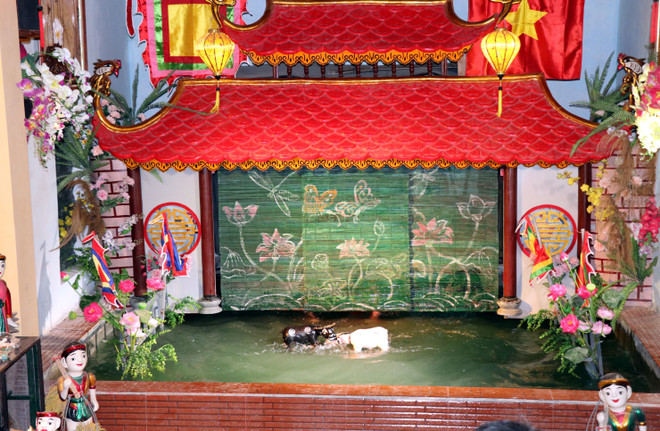
So that the puppet show is not forgotten
Through the ups and downs of history and social changes, there was a time when puppets lay still in dark rooms, covered with the dust of time.
Like many other traditional folk art forms, Ban Thach water puppetry faces many difficulties.
The old generation, the village's living archive, passed away, causing the traditional plays to gradually disappear. The young generation left their hometown to make a living, and few of the remaining villagers were interested in puppetry.
The emergence of more and more different forms of entertainment has gradually narrowed the position of water puppetry in modern life. However, in Ban Thach, there are still many people who are passionate about their ancestors' traditions, persistently preserving and making puppetry "live" in modern life with many different forms.
Although over 60 years old, artisan Phan Van Manh's hands and eyes are still very flexible and sharp.
Whenever there is an invitation to perform, he and the artists in the Song Que water puppet troupe are busy preparing, bringing their mobile water puppetry to the requested location.
Mr. Manh said that the brothers in the puppet troupe, normally each person has a job, struggling to make a living, but when there is an invitation to perform, everyone gathers to bring water pavilions, puppets, and sounds to serve the needs of people throughout the South and North.
His puppet troupe often performs for traditional festivals, schools or cultural events. In the past, people came to the water pavilion to watch water puppetry.
Nowadays, he brings water puppetry and water pavilions to wherever there are puppet lovers. The invitations to perform are sometimes quick, sometimes sparse.
In the early spring months, there are many performance invitations, but there are also times when I go an entire month without receiving any invitations.
However, at each performance, witnessing the excitement of students as well as visitors, he understands that water puppetry still has appeal and that is also the motivation for his troupe to continue performing.
In Rach village, in addition to the fixed water pavilion at the village pond, the village currently has 4 mobile water pavilions, mini water pavilions built by puppet troupes and by the people themselves with the desire to preserve and remind their descendants of traditional cultural values. At the same time, they are ready to serve tourists from all over the world, those interested in learning and researching about puppetry.
The villagers do not forget to teach their children the techniques of making and controlling puppets. Therefore, the young generation in the village, although not directly performing, can still control the puppets in each play.
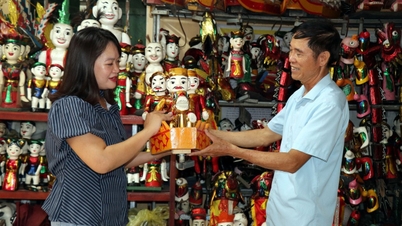
Mr. Phan Van Trien's Anh Duong Puppet Theater is a creative model that combines economic development from puppet production and tourism to promote the traditional art image of the locality.
Mr. Trien said that since he was a child, he learned puppetry and puppet making. Attached to, loving and appreciating traditional art, he opened a puppet making workshop that annually supplies the market with thousands of puppets of all different sizes and shapes. In recent years, Ban Thach village has become a popular tourist destination.
Grasping the development and needs of society, the puppets he creates not only serve performances but also become unique souvenirs imbued with the soul of the Vietnamese countryside, which are happily received by tourists.
In the house, he designed and built a miniature water pavilion ready to perform when guests come to visit.
From this model, each month his workshop welcomes about 10 groups of visitors to learn more. Because of that, many units contact to order puppets as gifts, helping his workshop have more jobs and revenue.
From the traveling performances of village puppet troupes to the colorful souvenir puppets that follow tourists everywhere, the cultural beauty of the locality and ethnic group is increasingly widely promoted, attracting the community's attention to the work of preserving and promoting this unique art.
In order to preserve the art of water puppetry, in 2023, the locality will invest in rebuilding the Nam Chan water puppetry theater with a budget of 200 million VND.
This is not only a place for activities and performances but also a cultural highlight, contributing to creating an attractive experience space for visitors when coming to Ban Thach village.
Bringing water puppetry into tourism activities opens up a new direction of development, both creating more livelihoods for people and being a driving force to preserve and promote the nation's long-standing cultural values./.
Source: https://www.vietnamplus.vn/ninh-binh-giu-nghe-thuat-mua-roi-nuoc-giua-nhip-song-hien-dai-post1081667.vnp

![[Photo] General Secretary To Lam receives the Director of the Academy of Public Administration and National Economy under the President of the Russian Federation](/_next/image?url=https%3A%2F%2Fvphoto.vietnam.vn%2Fthumb%2F1200x675%2Fvietnam%2Fresource%2FIMAGE%2F2025%2F12%2F08%2F1765200203892_a1-bnd-0933-4198-jpg.webp&w=3840&q=75)











































































Comment (0)