


China's trade surplus in the first 11 months of 2025 reached $1.076 trillion, setting a record high as the economy tries to diversify its markets and supply chains amid lingering concerns over the tariff war initiated by US President Donald Trump. This figure surpassed the record $992.2 billion for the whole of 2024, showing the relatively stable resilience of China's export industry amid fluctuating international demand.
Exports rose 5.9% year-on-year to $330.35 billion in November, reversing a 1.1% decline in October and beating the 3% increase forecast by financial data analytics firm Wind. Imports rose 1.9% year-on-year to $218.67 billion, but were below the 2.85% forecast. China recorded a trade surplus of $111.68 billion in November.
The surge in exports will support economic growth, while weak imports continue to reflect weak domestic demand, a challenge Beijing will need to address as it recovers, experts say. Lynn Song, China economist at ING, said the trade surplus widened by more than 22% year-on-year and will help bolster China's 2025 growth outlook. Zhang Zhiwei of Pinpoint Asset Management said China's economy is on track to grow by around 5% this year, in line with the government 's target.
Meanwhile, high-level trade talks with Washington helped improve market sentiment, although exports to the US continued to fall sharply. Chinese goods to the US fell 28.6% in November compared to the same period last year, after a 25.2% drop in October. Some analysts said the impact of the tariff cuts had only been partially reflected and could increase in the coming period. Trade tensions between the two major economies escalated in April, but the two sides reached an agreement to reduce tariffs and suspend export controls in late October.
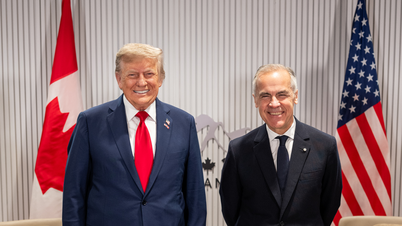
US President Donald Trump and Chinese President Xi Jinping spoke by phone in late November, before the US announced plans for Mr. Trump to visit China in April 2026. At the same time, tensions over rare earth minerals cooled when Beijing temporarily suspended export controls, leading to a 26.5% increase in rare earth exports compared to October to 5,493.9 tons.
Outside the US market, China's exports to the EU, Japan, South Korea and Africa increased by 14.8%, 4.3%, 1.9% and 27.6% respectively in November. This reflects efforts to expand markets amid rising geopolitical and trade risks.
In the agricultural sector, China imported 8.1 million tons of soybeans in November, down 14.5% from the previous month. The suspension of imports from five Brazilian suppliers in late November due to quality concerns has slowed agricultural trade between the two countries. While Washington said Beijing had agreed to buy an additional 12 million tons of soybeans through 2025 and maintain 25 million tons per year for the next three years, China has not given official confirmation.
In the chip sector, exports fell 1% month-on-month and imports fell 6.9%. Tensions over the company Nexperia between China and the Netherlands have also eased somewhat after the two sides reached a compromise allowing the resumption of some exports for civilian purposes and the Dutch side suspended its decision to control the company.
Observers expect the upcoming Politburo meeting and Central Economic Work Conference to outline policy directions for 2026, with the focus likely to remain on proactive fiscal stimulus and maintaining “moderately loose” monetary policy to support domestic demand, which is seen as key to the next phase of growth.
Source: https://baotintuc.vn/kinh-te/thang-du-thuong-mai-trung-quoc-vuot-moc-ky-luc-1000-ty-usd-20251208144716356.htm


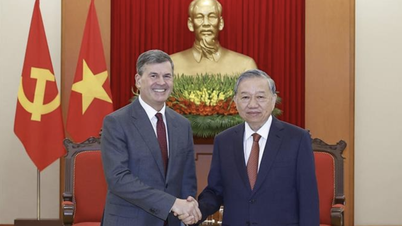
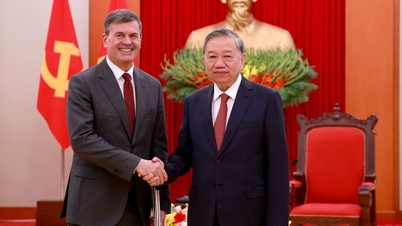
![[Photo] General Secretary To Lam receives the Director of the Academy of Public Administration and National Economy under the President of the Russian Federation](/_next/image?url=https%3A%2F%2Fvphoto.vietnam.vn%2Fthumb%2F1200x675%2Fvietnam%2Fresource%2FIMAGE%2F2025%2F12%2F08%2F1765200203892_a1-bnd-0933-4198-jpg.webp&w=3840&q=75)

















































































Comment (0)