

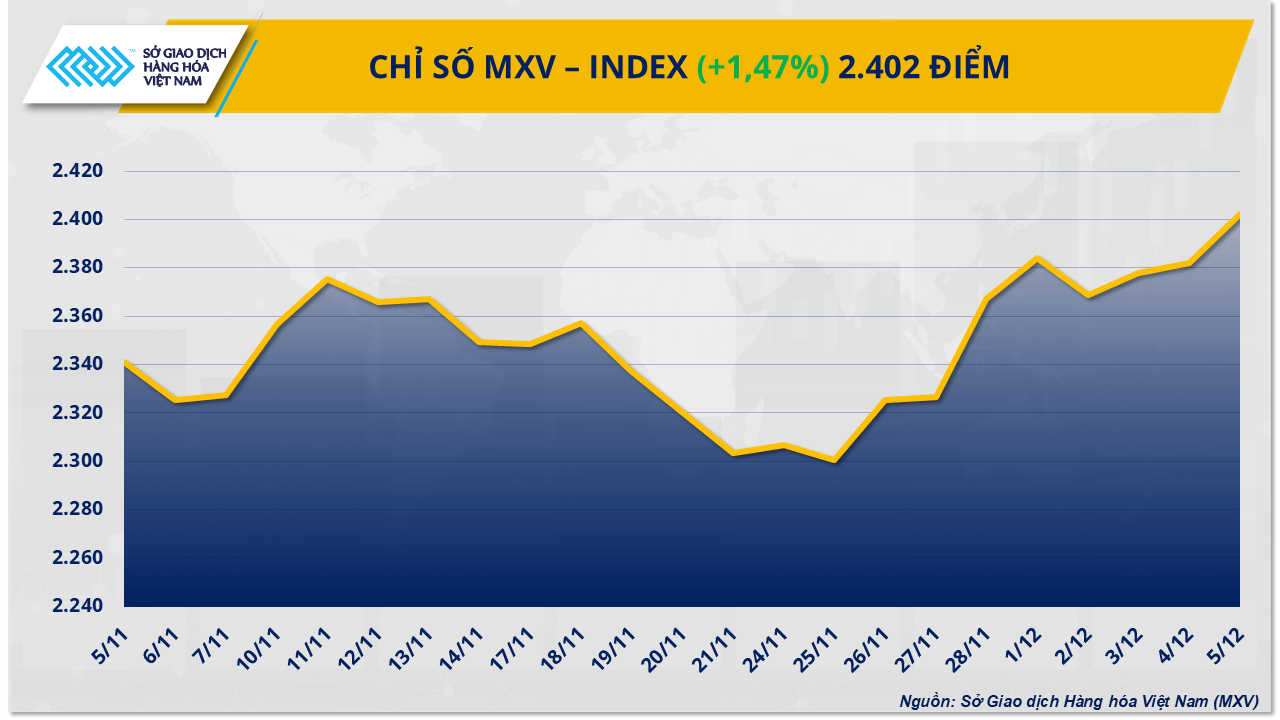
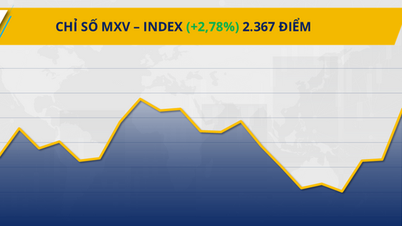
Meanwhile, the metal market was bustling as silver prices continued to climb to new highs thanks to expectations of a Fed rate cut. At the close, buying pressure dominated, pushing the MXV-Index up nearly 1.5% to 2,402 points - the highest level since January 2023.
Agricultural products under pressure from US-China trade, soybean prices down to one-month low
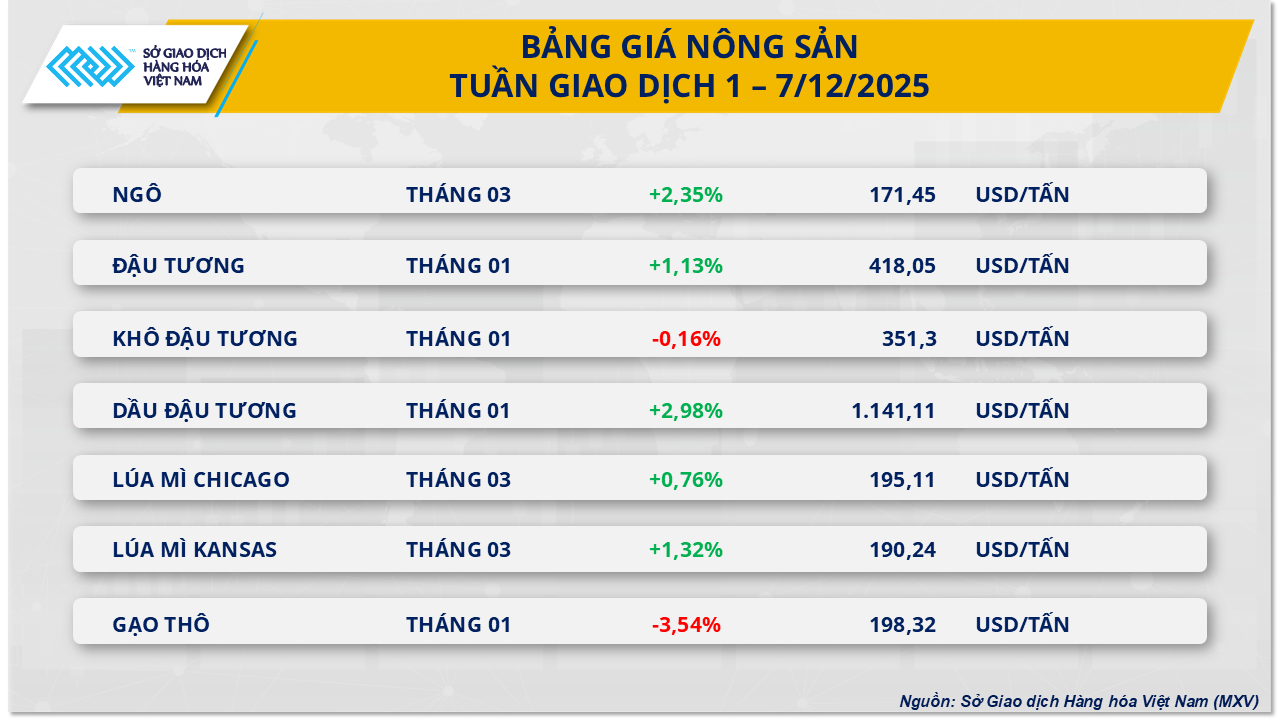
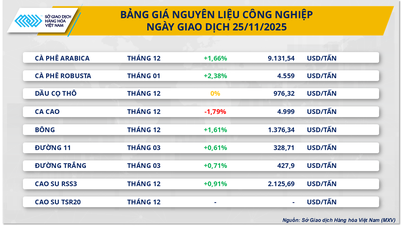
On the other hand, the agricultural market witnessed red covering most of the key commodities in the group. Notably, soybean prices lost nearly 3% of their value compared to the previous week, falling to 406.1 USD/ton, which is also the lowest level since the beginning of November.
According to MXV, the market is focusing on China’s import activities of soybeans and other agricultural products from the US. Currently, the US Department of Agriculture (USDA) has not announced any new orders from Beijing in December.
China’s total order volume since October 30 remained at 2.25 million tons. Some trade sources said the actual figure could be as high as 3-4 million tons, but that would still be too modest compared to the 12 million tons of soybean purchase commitment announced by the White House in early November.
On December 3, US Treasury Secretary Scott Bessent once again reassured the market by reaffirming his confidence that China would fulfill its commitment, but the deadline was also moved from the end of this year to the end of February 2026.
In addition, the market was also pressured by the statement of US Trade Representative Jamieson Greer, who said that the trade relationship between the two largest economies in the world should be narrowed and focused on non-essential goods. This statement not only put pressure on the soybean market but also spread to many other agricultural products.
This pressure caused the grain market to decline slightly last week, despite concerns about the security situation in the Black Sea, one of the world 's major supplies and also a key export route for Russia and Ukraine. At the end of the trading week, the prices of corn and wheat on the CBOT floor recorded a decrease of about 0.5-0.7% for the week.
On the supply side, world soybean prices are also being impacted by the expansion of the world's largest supplier, Brazil. Brazilian government data shows that, although weaker than October, the volume and value of soybean exports in November still increased by more than 64% compared to the same period last year, reaching 4.2 million tons and more than 1.8 billion USD.
Soybean production in 2025-26 is also forecast to increase, with Patria Agronegocios raising its forecast by 0.2% to nearly 172 million tonnes, up 1.4% from the previous season. Planted area is also expected to reach 48.58 million hectares, up 0.9% from the previous estimate and 1.9% from the previous season.
Silver prices rise sharply ahead of FED meeting
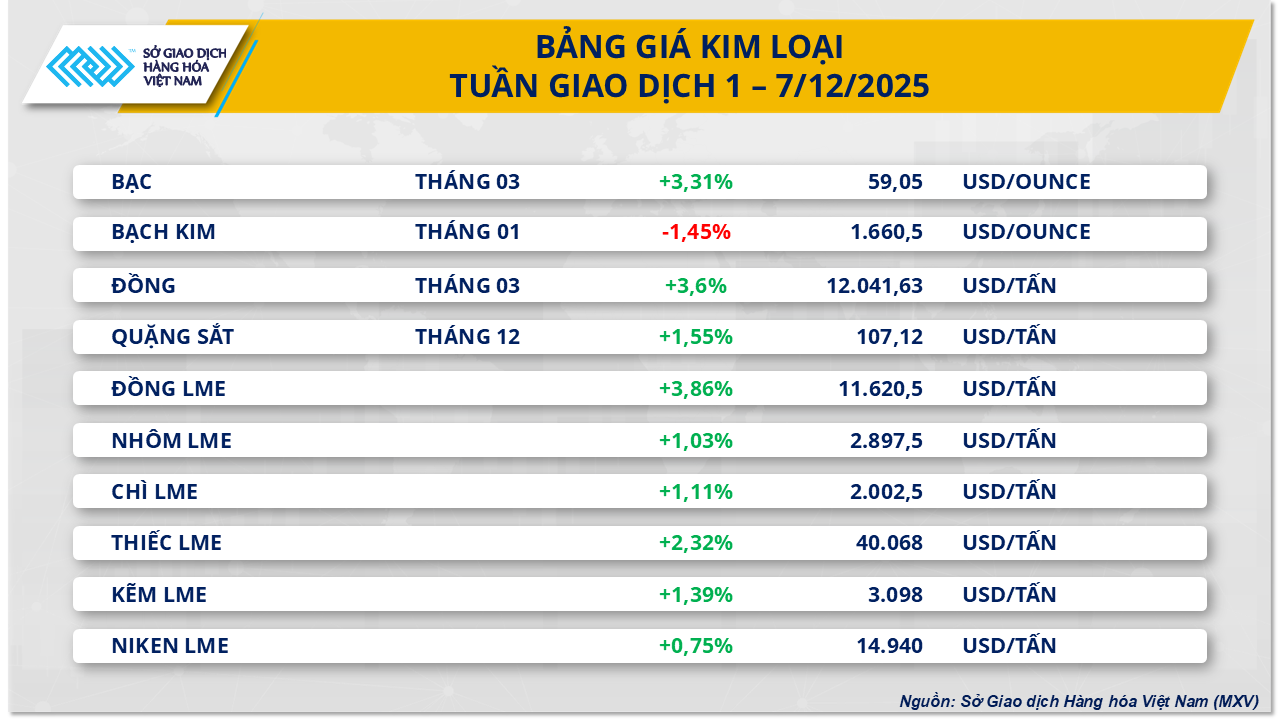
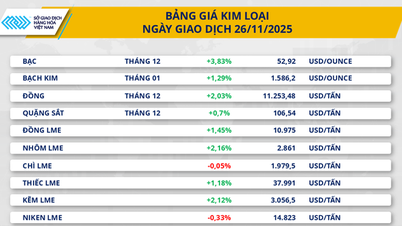
The trading week of December 1-5, 2025 witnessed a vibrant movement in the metal market, in which silver continued to be the focus as the price approached the $60/ounce mark. Closing the week, the March silver futures contract increased by 3.3% to $59.05/ounce, despite three correction sessions after reaching a historic peak. The strong recovery momentum in the final session of the week reflected that buying power remained strong.
Expectations that the US Federal Reserve will cut interest rates at its year-end policy meeting are the main driver behind the silver rally. According to the FEDWatch tool, the probability of the Fed cutting by 25 basis points at the next meeting is 87.2%.
Recent economic data reinforced this possibility as the personal consumption expenditures (PCE) report - the Fed's preferred inflation measure - rose 0.3% month-on-month and 2.8% year-on-year, while core inflation fell to 2.8%, in line with forecasts. The University of Michigan's consumer sentiment index improved to 53.3, with one-year inflation expectations falling to 4.1%, indicating confidence that price pressures will continue to ease.
Meanwhile, the US labor market continued to slow. The private sector lost 32,000 jobs in November; the number of jobs cut since the beginning of the year exceeded 1.2 million - a five-year high. These signals pushed the USD index (DXY) down for the second consecutive week to 98.99 points, thereby supporting the price of silver, which is priced in USD.
In addition to macro factors, tightening supply in the US also supported prices. Washington's consideration of adding silver to the list of critical minerals raised concerns about the possibility of imposing import tariffs. Hedging sentiment led to a strong flow of physical silver into the US; COMEX inventories as of December 5 reached over 14,220 tons, up more than 40% compared to the beginning of the year.
However, industrial silver demand remains an unknown as manufacturing activity in the world’s two largest consumer markets continues to weaken. The November manufacturing PMI in both the US and China was below the 50-point threshold, indicating a contraction in the industrial sector. This is a factor that could put pressure on silver consumption in the medium term, especially in areas such as electronics, solar energy or technology equipment.
Domestically, silver prices last week also closely reflected international developments. Silver 999 increased by more than 3%, with listed prices in Hanoi fluctuating between 1.9 and 1.93 million VND/tael; in Ho Chi Minh City, they were commonly between 1.902 and 1.936 million VND/tael. Silver trading activities were also more active than last week, as many people took advantage of mid-week adjustment sessions to add to their holdings while world prices remained high.
Source: https://baotintuc.vn/thi-truong-tien-te/thi-truong-hang-hoa-soi-dong-mxvindex-len-vung-2400-diem-20251208083146293.htm


![[Photo] General Secretary To Lam receives the Director of the Academy of Public Administration and National Economy under the President of the Russian Federation](/_next/image?url=https%3A%2F%2Fvphoto.vietnam.vn%2Fthumb%2F1200x675%2Fvietnam%2Fresource%2FIMAGE%2F2025%2F12%2F08%2F1765200203892_a1-bnd-0933-4198-jpg.webp&w=3840&q=75)
































































































Comment (0)