

Removing difficulties that have existed for many years in implementing major projects in the capital
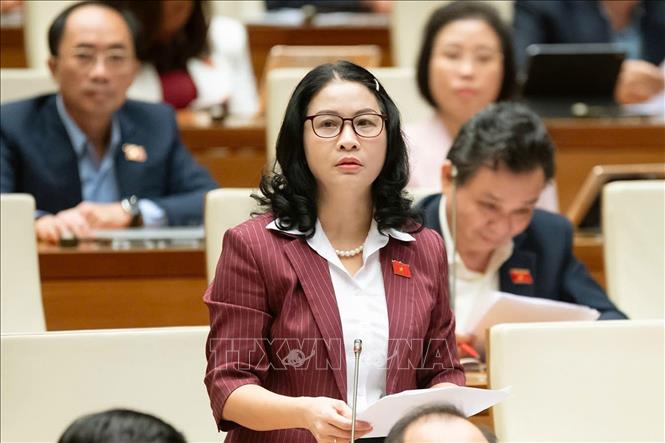
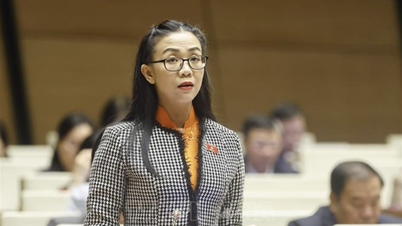
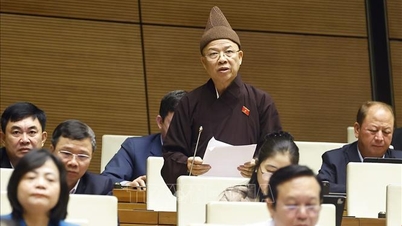
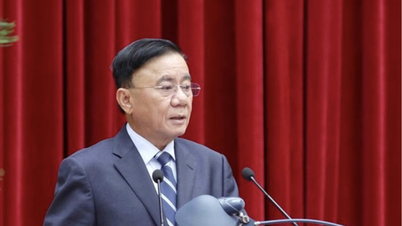
Delegate Nguyen Thi Lan (Hanoi) agreed with and strongly supported the issuance of the National Assembly Resolution on specific mechanisms and policies to implement large projects in the capital; saying that this is an objective and timely requirement, aiming to remove difficulties that have existed for many years in the process of implementing large projects in the capital.
According to the delegate, reality shows that Hanoi is having to simultaneously solve many very heavy tasks: developing infrastructure, reducing traffic jams, preventing flooding, handling environmental pollution, urban beautification and reconstruction... in conditions of limited space, high population density and increasingly large development requirements. However, many important projects have not achieved the desired progress due to obstacles in investment procedures, overlapping planning, complicated site clearance and limited resource mobilization mechanisms. In that context, if we continue to completely apply conventional mechanisms, it will be very difficult to create a clear change. Issuing a pilot Resolution is an appropriate approach, both to remove the "bottleneck" in the immediate future and to test and perfect the institutions for the next phase.
Highly appreciating the draft Resolution with its groundbreaking provisions but with strict control, delegate Nguyen Thi Lan said that the draft has boldly decentralized and delegated power to the Capital City government, helping to shorten the process, enhance responsibility and initiative in implementation, but still within the framework of the Constitution, laws and supervision of the National Assembly and the Government .
At the same time, the Resolution hits core bottlenecks such as planning, investment procedures, land acquisition, urban reconstruction, thereby creating conditions for faster implementation of truly urgent projects with large spillover effects. The draft clearly demonstrates the spirit of putting people at the center, through compensation, support, and resettlement mechanisms higher than general regulations; at the same time, emphasizing the requirements of publicity, transparency, and anti-corruption and group interests in the implementation process.
"This resolution is not a special favor for the Capital, but a limited pilot mechanism, with the goal of helping Hanoi better fulfill its assigned role and responsibility as the national political and administrative center, and at the same time a major center of culture, economy, science, technology and education and training of the whole country. A more smoothly developed, greener and more efficient Capital will reduce pressure on neighboring localities, increase regional connectivity and create a common development momentum for the whole country," delegate Nguyen Thi Lan emphasized.
For the Resolution to be effectively implemented, delegates proposed to strengthen close coordination between the Central Government and the city, especially with projects that have inter-regional and inter-sectoral impacts. During the implementation process, it is necessary to pay attention to the legitimate rights of people and organizations, publicize information, communicate early and fully to people, create consensus and sharing from the beginning. Along with that, it is necessary to regularly monitor and evaluate the pilot process, promptly adjust any arising shortcomings, in line with the spirit of controlled piloting.
Delegate Hoang Van Cuong (Hanoi) agreed with the policy of issuing a Resolution to pilot specific mechanisms and policies to implement large and important projects in the capital in an open and convenient manner to attract the most optimal investment resources.
Agreeing with the provisions in Article 10 on measures to renovate, beautify and rebuild urban areas when more than 75% of homeowners and users of 75% of the land area in the renovation area agree and are allowed to decide on planning, architectural and population targets, delegates said that without this mechanism, it would be impossible to renovate old, degraded and unsafe apartment buildings, and crowded self-built houses with no escape routes in case of fire or explosion.
This mechanism will allow for the overall renovation of both old apartment buildings and low-rise buildings interwoven into modern, civilized urban areas: Developing the space above ground as a place for residence; the entire underground space below ground as a place for business services and underground transportation; the space above ground as green trees and public space. Therefore, delegates proposed that it must be regulated that urban reconstruction areas with increased population density must follow the TOD model: High-rise buildings above, subway stations below and underground space for service development.
Ensuring transparency of financial and land mechanisms
Regarding the draft Resolution of the National Assembly amending and supplementing a number of articles of Resolution No. 98/2023/QH15 on piloting a number of specific mechanisms and policies for the development of Ho Chi Minh City, delegate Hoang Van Cuong pointed out that after merging Binh Duong and Vung Tau, the position and potential of Ho Chi Minh City will grow stronger both domestically and internationally, which no other locality can compare to.
With such a large entity, Ho Chi Minh City does not wear the same institutional coat as other localities in the country, but needs to have a different and more open legal framework, giving Ho Chi Minh City its own space for freedom of creativity and controlled development. That is the goal and mission that this Resolution must achieve.
Basically, the delegates agreed with all the mechanisms and policies on developing the TOD urban model, on urban planning and management, on attracting strategic investors, and on the proposal to establish a free trade zone. At the same time, the delegates proposed to add one more content to this Resolution, which is: In case there is a need for specific regulations different from the current regulations, the People's Council shall issue a resolution and report to the Government so that the Government can submit it to the National Assembly Standing Committee for consideration and report to the National Assembly at the nearest session.
Commenting on the draft Resolution of the National Assembly amending and supplementing a number of articles of Resolution No. 136/2024/QH15 on the organization of urban government and piloting a number of specific mechanisms and policies for the development of Da Nang city, delegate Nguyen Tam Hung (Ho Chi Minh City) said that after the merger, Da Nang has the largest area in the country among the Central urban groups; the pressure to connect East - West and North - South requires a breakthrough in infrastructure.
Therefore, the delegates fully support allowing Da Nang city to decide on planning and technical indicators other than national standards in the TOD area, as well as allowing multi-functional development on station land, retaining 100% of TOD revenue to reinvest in urban railways. This is a mechanism in line with international practices, creating momentum to form new growth poles. However, the delegates noted the need to add accompanying requirements: ensuring adequate technical and social infrastructure and controlling population density, avoiding spontaneous development.
Regarding the shortening of planning procedures in Clause 1a, Article 11, delegates strongly supported the mechanism that allows the simultaneous establishment of tasks and detailed planning, one-time consultation, and allows investors to participate in planning once selected. This is a major reform step, consistent with the 2024 Law on Urban and Rural Planning and the practices of dynamic cities. This mechanism helps Da Nang speed up planning, shorten project preparation time, reduce administrative procedure costs, and attract strategic investors.
Agreeing and proposing that the National Assembly pass these two Resolutions, in order to create a superior institutional framework, helping Ho Chi Minh City and Da Nang City become two new growth poles, making strong contributions to national development, delegate Nguyen Tam Hung suggested that the Drafting Committee continue to review to ensure transparency of the financial - land mechanism in TOD of both localities. Along with that, control the quality of planning according to mandatory criteria, avoid hot development; increase accountability and supervision mechanisms from People's Councils at all levels so that the Resolution can be effectively implemented.
In this morning's session, the National Assembly also discussed in the hall the second state budget supplement (foreign non-refundable capital) in 2025.
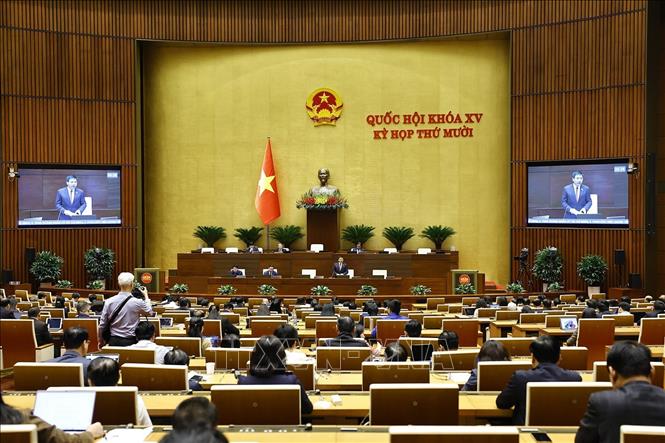
During the remaining time of the morning session, the National Assembly discussed in groups the draft Law on amending and supplementing a number of articles of the Law on Value Added Tax. Delegates requested the drafting agency to carefully assess, anticipate and clarify the risks, frauds and legal gaps that may occur for officials in the work of value added tax refunds; handling measures and responsibilities of state management agencies in cases of fraudulent value added tax refund invoices causing loss of revenue to the budget.
Source: https://baotintuc.vn/chinh-tri/tao-khuon-kho-phap-ly-vuot-troi-giup-tp-ho-chi-minh-va-da-nang-phat-trien-but-pha-20251208131216652.htm

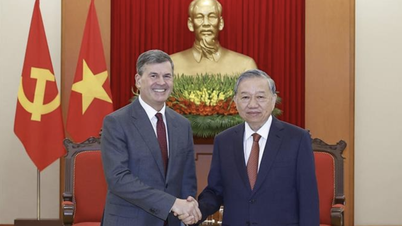
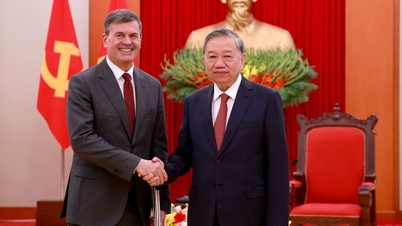
![[Photo] General Secretary To Lam receives the Director of the Academy of Public Administration and National Economy under the President of the Russian Federation](/_next/image?url=https%3A%2F%2Fvphoto.vietnam.vn%2Fthumb%2F1200x675%2Fvietnam%2Fresource%2FIMAGE%2F2025%2F12%2F08%2F1765200203892_a1-bnd-0933-4198-jpg.webp&w=3840&q=75)










































































Comment (0)